

Age Calculator: Determine Chronological & Biological Age
Table of Contents
Why Precision Matters in Age Calculation
Understanding how to calculate age may seem simple, yet the implications of inaccuracy can be significant. Whether verifying legal eligibility, assessing medical risks, or planning for retirement, a single day's difference can have considerable real-world consequences. Age is not merely a number; it's a legal threshold, a clinical variable, and a financial determinant simultaneously. Utilising an age calculator online ensures precision and reliability in these critical assessments.
The Hidden Flaw in Simple Subtraction
The most prevalent method — subtracting a birth year from the current year — is surprisingly error-prone. It often overlooks whether the person's birthday has occurred in the current calendar year, leading to inaccuracies. For instance, someone born in November checked in February might appear one year older than they legally are.
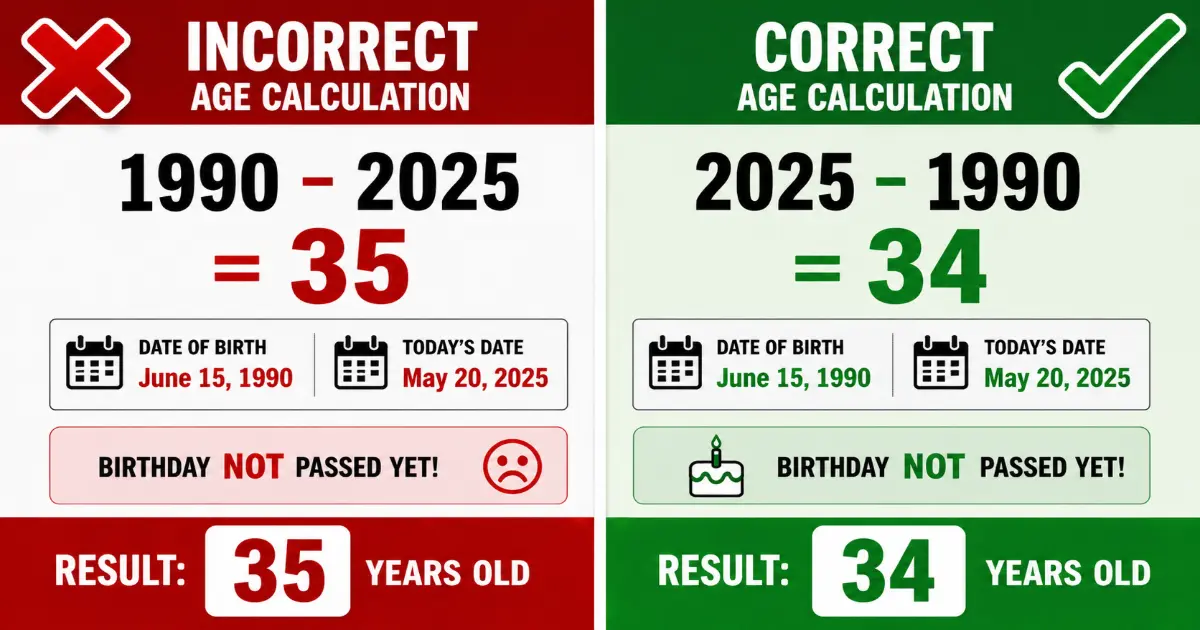
This isn't a rare edge case. Statistically, any given date falls before someone's birthday roughly 50% of the time during the year. In high-volume data environments — such as payroll systems, patient records, and eligibility databases — such errors compound significantly. A simple subtraction approach introduces inaccuracies across numerous records, particularly when the timing of the birthday relative to the query date is ignored.
Where Precision Has Real Consequences
Chronological age — the exact elapsed time between a birth date and a reference date — is crucial for decisions across various domains:
- Legal eligibility: Age gates for voting, driving licences, alcohol purchase, and financial contracts rely on precise dates, not approximate years.
- Retirement planning: State Pension entitlement in the UK depends on specific birth date thresholds, where even a single day can impact payment timing.
- Medical diagnostics: Clinical screening programmes, paediatric dosage calculations, and insurance underwriting all depend on age precision measured in months or even days.
The ICO's guidance on age assurance technologies underscores the importance of reliable age determination in regulated digital environments.
Understanding why precision matters is the first step — but the real complexity lies in how modern tools compute that precision. The mechanics behind accurate age calculation reveal surprising subtleties that even well-designed systems frequently overlook.
The Mechanics of Chronological Age: How Tools Calculate Time
Precision in age calculation starts with understanding what is actually being measured. Chronological age is the elapsed time between a person's date of birth and any target date — whether today, a past event, or a future milestone. The challenge lies in the fact that time doesn't move in perfectly equal units.
Handling Variable Month Lengths
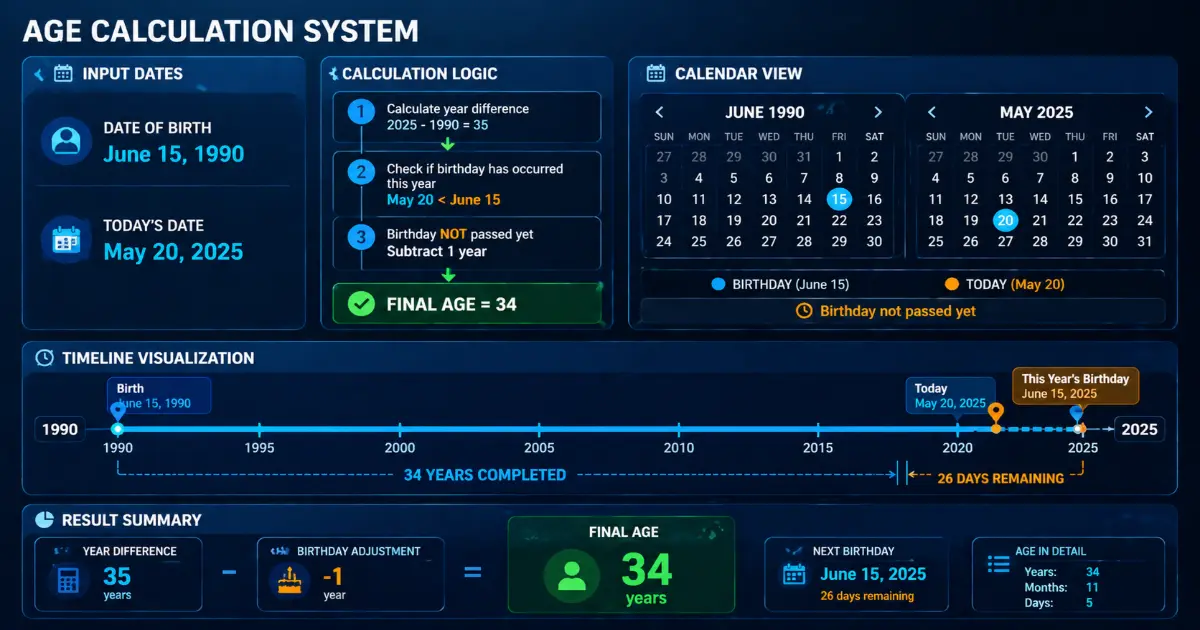
The fundamental complication in age calculation is that months can vary between 28 and 31 days. A naive system counting raw days and dividing by an average figure introduces subtle errors. The correct approach uses date-component logic: comparing the day and month of the birth date against the target date's day and month, rather than converting everything into days.
In practice, this means an age counter must:
- Subtract the birth year from the target year to get a baseline figure.
- Check whether the birthday has occurred yet within the target year.
- Subtract one year from the result if the anniversary has not yet passed.
This ensures a reliable age calculator online produces results that align with legal and administrative records, replicating calendar logic rather than arithmetic averaging.
Why Dividing by 365.25 Falls Short
The 365-day fallacy: Dividing the total number of days between two dates by 365 (or even 365.25 to account for leap years) doesn't yield chronological age in completed years — it results in a decimal approximation that is legally and clinically imprecise.
The 365.25 method smooths out leap years over time but doesn't reflect which specific years in a person’s life contained a 29th February. For a child born on 28/02/2000, this distinction matters acutely. Actuarial standards, such as those in the NAIC Valuation Manual, treat exact age as a discrete, calendar-based value — not a floating decimal.
Calculating Age Against Any Target Date
Age calculation often requires determining age as of a specific reference date — such as a contract signing date or a medical assessment date. The logic remains identical; only the endpoint variable changes.
Standardising inputs is crucial. When using any date-based system, clarity about which date is the "start" (date of birth) and which is the "end" (reference date) eliminates ambiguity. Swapping these values — even accidentally — leads to nonsensical negative results or inflated figures.
Mastering these principles is foundational. Once solid, the logical step is applying them at scale — precisely where tools like Excel become indispensable for managing large datasets of individuals across HR systems and research rosters.
Professional Age Calculation: Excel and Data Management
For HR managers, clinical researchers, and data analysts, a date calculator age function in spreadsheet software is often the most practical solution available. Excel and Google Sheets support powerful date arithmetic — but using them correctly requires knowing which tools to reach for and, critically, which common shortcuts to avoid.
Mastering DATEDIF for Professional Databases
DATEDIF: A spreadsheet function that calculates the difference between two dates across a specified interval — years, months, or days — accounting for variable lengths of calendar months and leap years.
The DATEDIF function is the backbone of professional age calculation in spreadsheet environments. Its syntax is straightforward: =DATEDIF(birth_date, reference_date, "Y"). The "Y" parameter is what distinguishes reliable age calculation from approximation — it instructs the function to count only fully completed years, avoiding rounding or estimating based on a fixed-day count.
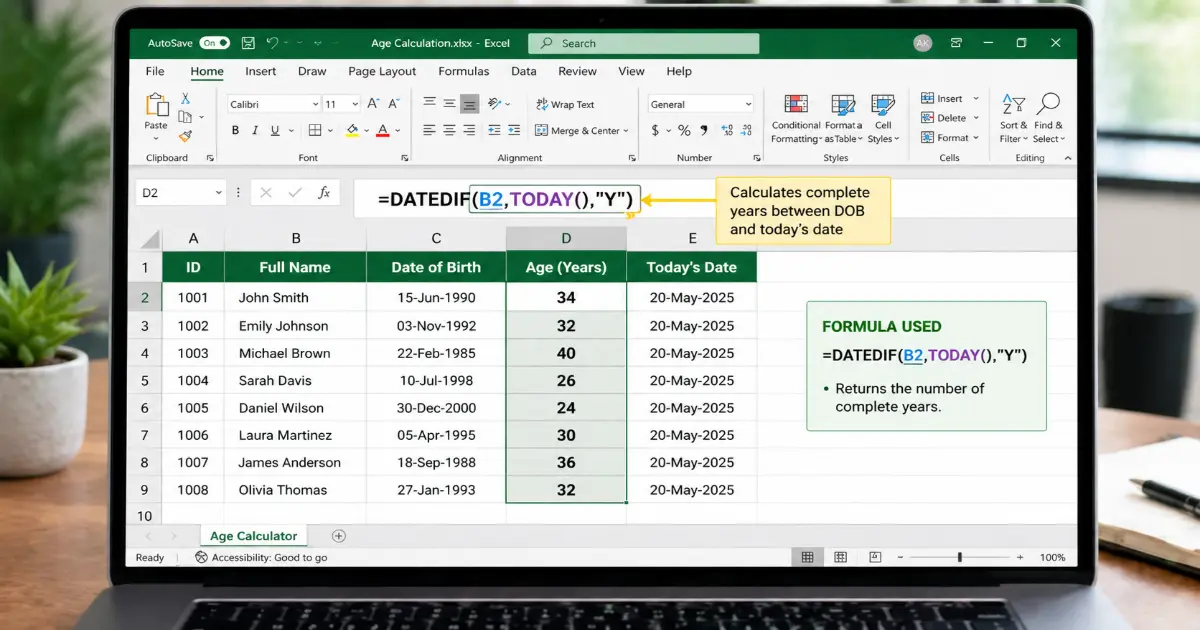
In practice, this distinction matters considerably. A person born on 15/03/1990 assessed on 14/03/2025 hasn't reached their 35th birthday. The "Y" parameter correctly returns 34. Alternative approaches — particularly dividing by 365 — would incorrectly return 35, introducing errors across large rosters.
The 365-Day Division Error
The most common pitfall in spreadsheet age arithmetic is dividing the day difference between two dates by 365.
This method ignores leap years entirely. Over ten years, this omission introduces a discrepancy of two to three days per person — trivial in isolation but potentially significant when compliance thresholds, pension eligibility, or clinical trial enrolment criteria hinge on exact ages. The DATEDIF function with the "Y" parameter eliminates this risk by operating directly on calendar logic rather than day counts.
A secondary pitfall involves date formatting. Cells that appear to contain dates may actually store text strings, causing functions to return errors or — more dangerously — incorrect values. Validating date columns before running any age calculation is essential hygiene in any professional database.
Automating Age Updates in Dynamic Rosters
Static age fields are a liability. An employee record capturing age at the point of hire becomes increasingly inaccurate over time. The solution is to anchor age calculations to TODAY(), ensuring ages update automatically when a spreadsheet refreshes: =DATEDIF(A2, TODAY(), "Y").
This approach is particularly valuable in NHS patient rosters, HR compliance systems, and research cohort databases, where age-banded reporting must remain current without manual intervention. Combined with conditional formatting — flagging individuals approaching age-related thresholds — automated age columns transform static records into genuinely responsive data tools.
For those managing beyond spreadsheets — or seeking tools that surface not just years but months, weeks, and meaningful milestones — the next section evaluates the best online age calculators available.
Evaluating the Best Online Age Calculators and Software
Not all age calculation tools are created equal. As discussed, precise chronological age computation involves more than subtracting one year from another — and the best digital tools reflect that complexity. Whether verifying eligibility or tracking a personal milestone, choosing the right tool for online age calculation by date of birth can greatly enhance accuracy and experience.
What Separates a Standard Tool from a Specialist One
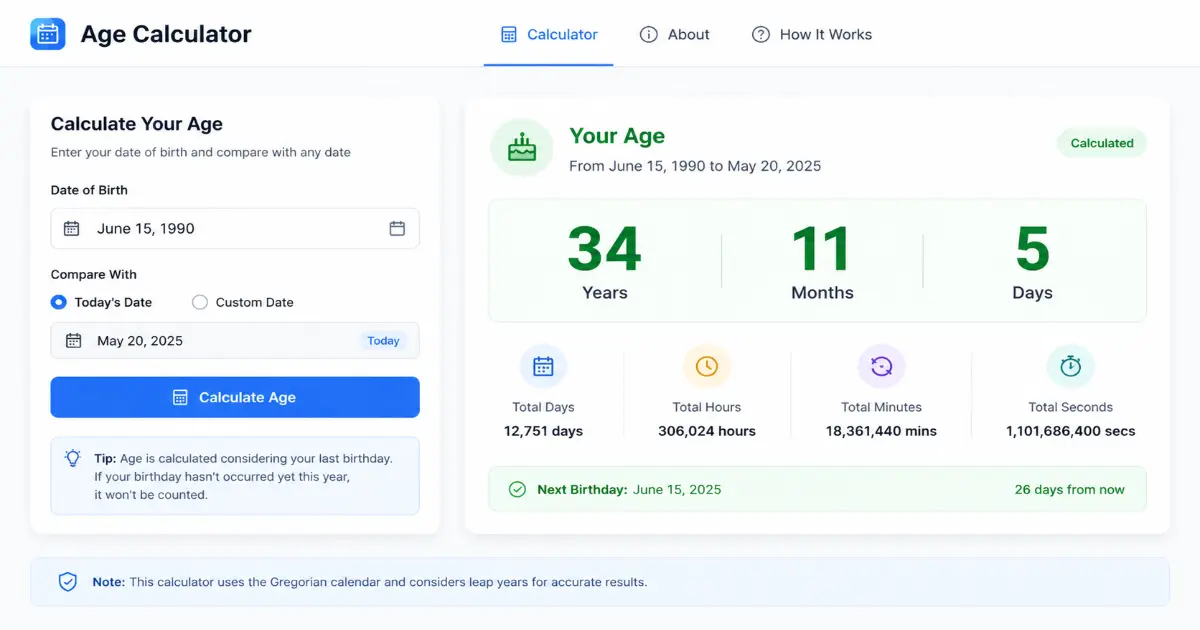
Special Age Calculator: A tool that goes beyond outputting years alone, presenting results in multiple time units — including months, weeks, days, hours, minutes, seconds, and estimated heartbeats — to give users a richer picture of elapsed time.
A basic tool might indicate someone is 34 years old. A specialist tool will tell you they are 34 years, 7 months, 12 days, roughly 18,000 days, approximately 432,000 hours, and an estimated 1.4 billion heartbeats into their life. That granularity serves real purposes: insurers, clinicians, legal professionals, and HR teams benefit from sub-year precision rather than rounded figures.
Key features worth prioritising when selecting a tool:
- Multi-unit output — Days, weeks, months, and years displayed simultaneously.
- Milestone detection — Alerts for upcoming significant birthdays or anniversaries.
- Leap year awareness — Accurate handling of 29 February edge cases.
- Time zone support — Critical when birth records span different regions.
- Customisable reference dates — Calculating age for a past or future date, not just today.
Mobile App vs. Browser-Based Tool
The choice between a dedicated mobile application and a web-based calculator often depends on frequency of use and context. A mobile app, such as a dedicated date-of-birth calculator, suits professionals who need quick lookups in the field — a GP reviewing a patient's notes or an HR manager at a recruitment event. Browser-based tools, however, are better suited to detailed analysis requiring a larger display. In practice, browser tools typically offer richer interfaces with more configuration options.
Privacy: A Consideration Worth Taking Seriously
The ICO's guidance on age assurance technologies highlights that date-of-birth data constitutes personal information under UK data protection law. Entering a full DOB — particularly for a third party like a child or patient — into an unverified website carries genuine risk. Before using any tool, check for a published privacy policy, confirm data is processed client-side where possible, and avoid platforms that require account registration simply to perform a basic calculation.
The rule of thumb is straightforward: if a tool doesn't need your data to function, it shouldn't be asking for it.
Choosing the right calculator tool is ultimately about matching functionality to purpose — but it's worth remembering that chronological age, however precisely measured, tells only part of the story. The next section examines how biological age can diverge significantly from the numbers on a birth certificate, and why that distinction increasingly matters to health professionals.
Chronological vs. Biological Age: The Health Perspective
When you calculate age from a date of birth, you arrive at chronological age — the straightforward count of years, months, and days elapsed since birth. It's the number on your passport, the figure your GP records, and the baseline every medical professional references first. But chronological age tells only part of the story.

What Is Biological Age?
Biological age: A measure of how well — or how poorly — your cells, tissues, and organ systems are functioning relative to population norms for a given chronological age bracket.
Where chronological age is fixed and immutable, biological age is dynamic. It's shaped by biomarkers including telomere length, inflammatory markers such as C-reactive protein, cardiovascular efficiency, and metabolic panel results. Two individuals born on the same date can carry vastly different biological ages depending on lifestyle, environment, genetics, and healthcare access.
Chronological age is your starting point. Biological age is your score.Why Medical Assessments Prioritise Biological Markers
Clinicians and researchers increasingly look beyond birth dates because chronological age alone is a poor predictor of health outcomes. In practice, a 55-year-old with optimal cardiovascular fitness, healthy BMI, and low inflammatory markers may carry the biological profile of someone a decade younger — and vice versa.
This matters practically in several contexts:
- Surgical risk assessments: Anaesthetists often evaluate functional age over calendar age.
- Cancer screening intervals: Adjusted based on cellular health indicators.
- Medication dosing: Renal and hepatic function tests frequently override age-based defaults.
- Insurance underwriting: Increasingly incorporates biometric data alongside date-of-birth records.
On the other hand, chronological age remains legally and administratively essential. It determines eligibility thresholds, pension entitlements, and clinical trial criteria — areas where a precise, date-verified figure is non-negotiable.
Using Chronological Age as a Health Baseline
One practical approach is to treat your chronological age as a neutral benchmark against which biological progress can be measured. Regular health screenings — ideally every 12 months after the age of 40 — allow you to track whether lifestyle interventions are genuinely shifting your biological markers in a favourable direction.
Example scenario: A 48-year-old begins a structured exercise and nutrition programme. Repeat biomarker testing 18 months later may show arterial stiffness and glucose regulation consistent with a 41-year-old profile. The chronological age hasn't changed — but the biological trajectory has shifted meaningfully.
Understanding both figures together gives a far richer picture of health. It's worth noting that this duality of age measurement is largely a Western biomedical framework — something that becomes even more nuanced when you consider how different cultures define and count age in the first place.
Global Perspectives: Cultural Variations in Age Counting
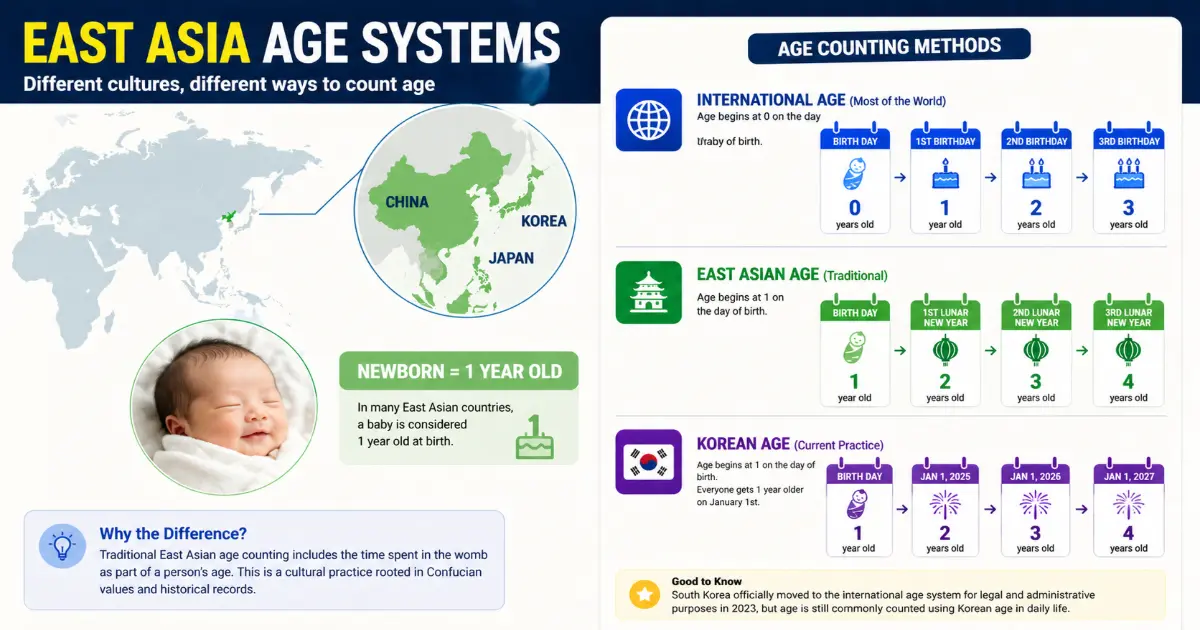
How age is counted is far from universal. Whilst most Western nations rely on the Gregorian chronological system — measuring the precise number of years elapsed since birth — several East Asian cultures have historically used entirely different frameworks. Understanding these distinctions matters whenever age is used for legal, medical, or administrative purposes across international borders.
The Traditional East Asian Age System
Traditional Age Counting (East Asian Reckoning): A system in which a person is considered one year old at the moment of birth, with an additional year added at each New Year rather than on the individual's birthday.
Under this system, a baby born on 30th December could technically be considered two years old by 1st January — just two days later. The logic is rooted in cultural tradition: the time spent in the womb counts as the first year of life, and the New Year collectively ages everyone by one year simultaneously. In practice, this means East Asian traditional ages can run one to two years ahead of the Western chronological equivalent.
The Role of the Lunar New Year
The Lunar New Year complicates matters further. Because the Lunar calendar shifts relative to the Gregorian calendar each year, the precise moment at which a person gains a year under traditional reckoning varies annually. A person born in late January might gain their traditional "new year" increment within days, while someone born in February could wait nearly a full Gregorian year. This variability makes standardised conversion between systems genuinely complex.
Reconciling Systems for Legal and International Documents
International organisations — including those governing passports, medical records, and cross-border legal agreements — almost universally default to the Gregorian chronological age for formal documentation. The United Nations demographic standards confirm that population data relies on standardised birth-date reckoning, regardless of the registrant's cultural background.
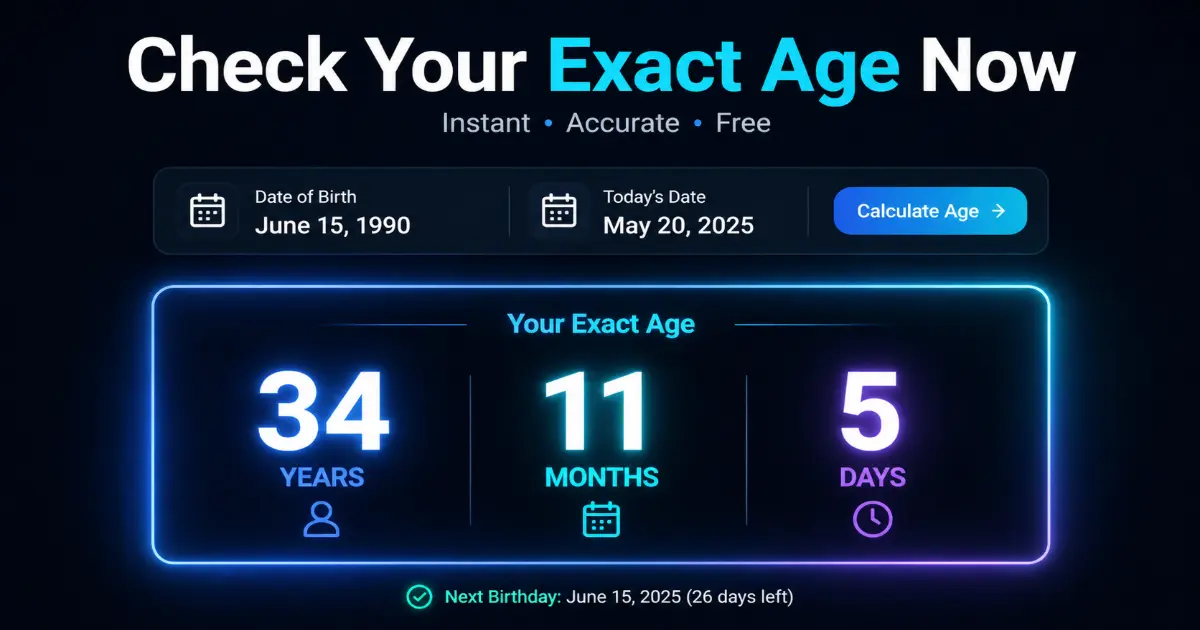
For individuals navigating both systems, using the best free online age calculator — one that accepts a specific date of birth and calculates against any reference date — is the most reliable way to produce a legally recognised chronological age on demand.
These cultural nuances raise a broader question: when an exact age is needed, which date serves as the reference point? That leads naturally to some of the most frequently asked practical questions about age calculation — covered next.
Common Questions: Calculating Age from Specific Dates
Age calculation questions arise constantly — from verifying eligibility for a service to settling a friendly debate about how old a historical figure was at a pivotal moment. Understanding the most reliable methods helps you get accurate answers quickly, whatever the situation.
Can an Age Calculator Work for Any Past Date?
Yes, absolutely. A well-designed age calculator does not simply measure the gap between a birth date and today. It can determine the precise time duration in years, months, and days between any two dates you specify. This makes it equally useful for calculating how old someone was in 1945, how long a business has been trading, or how many years have passed since a significant event.
In practice, you simply enter a start date (the date of birth or origin) and a target date (any point in the past or future). The tool handles leap years, varying month lengths, and calendar anomalies automatically — details that manual arithmetic can easily miss.
How to Calculate Age from a Date of Birth Without a Dedicated Tool
If a specialist calculator is not to hand, a standard spreadsheet application works reliably. In most spreadsheet programmes, the formula =DATEDIF(A1,B1,"Y") calculates completed years between two dates entered in cells A1 and B1. This approach is particularly useful for bulk calculations involving multiple individuals, such as employee records or eligibility assessments.
The Simplest Manual Method for Quick Estimations
When no device is available, a straightforward mental arithmetic approach works well:
- Subtract the birth year from the current (or target) year.
- Adjust by one if the birthday has not yet occurred within that year.
Example scenario: A person born on 15/08/1990, and today is 10/03/2025 — the initial subtraction gives 35, but since August has not yet arrived, the correct age is 34.
Knowing which method fits your situation means fewer errors and greater confidence in every age-related decision you make. Whether you rely on an online calculator, a spreadsheet formula, or a quick mental calculation, accurate age determination is well within reach — start with the method that suits your circumstances today.
Key Takeaways
- Legal eligibility: Age gates for voting, driving licences, alcohol purchase, and financial contracts depend on exact dates, not approximate years.
- Retirement planning: State Pension entitlement in the UK is tied to specific birth date thresholds, where even a single day can affect payment timing.
- Medical diagnostics: Clinical screening programmes, paediatric dosage calculations, and insurance underwriting all rely on age precision measured in months or even days.
Related articles
Keep reading similar topics
The Truth Behind DOB Calculators: Why They Go Viral
Ever wonder why birth date calculators are so addictive? Discover the psychology behind viral DOB trends, astrology charts, and the secrets hidden in your birth.
Precision Word Counter: Accurate Character & Word Count Tool
Need an accurate word count? Use our professional word counter tool to ensure your writing meets strict length requirements for publishing, SEO, and more.
Why the Best Online Word Counter Is Your Ultimate Writing Tool
Stop using basic calculators. Discover why a professional word count checker is an essential writing assistant for precision, clarity, and better content.