
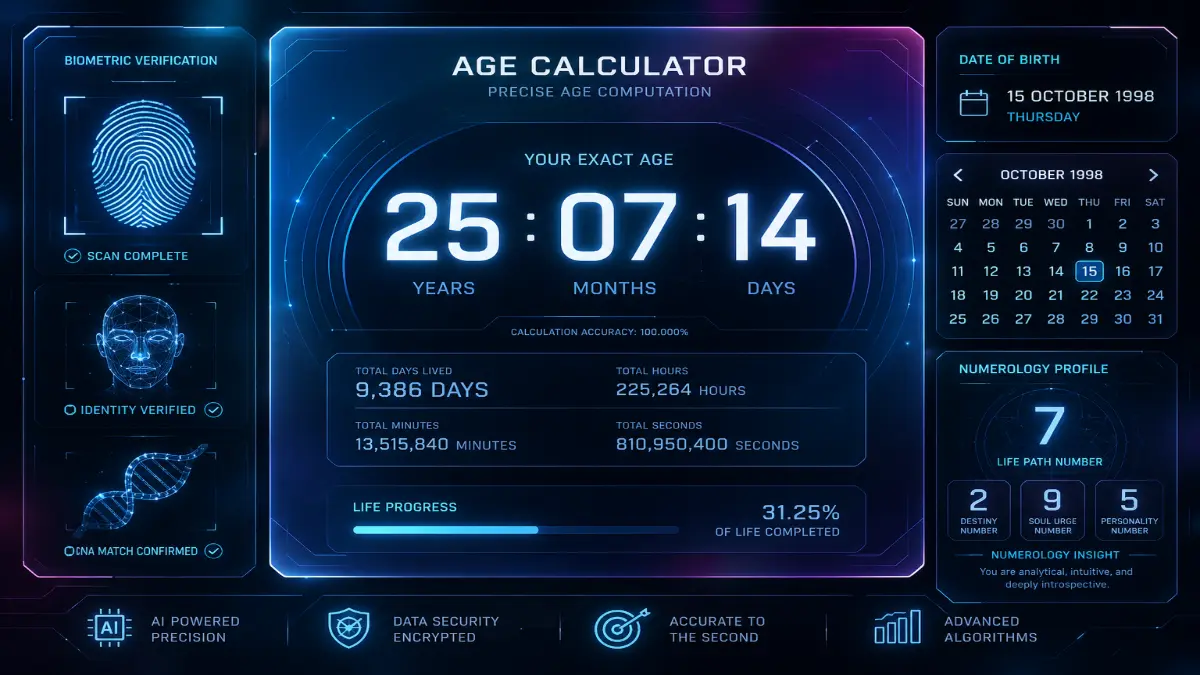
Age Calculator Verify Your DOB & Birth Date Instantly
Table of Contents
The 2026 Convergence: Why Your Birth Date is More Than a Number
Something shifted in 2026. Your date of birth — once a throwaway field on a signup form — is now the single most verified piece of personal data on the internet. And whether you're registering for a social platform, accessing age-restricted content, or proving eligibility for a service, an age calculator has quietly become one of the most-used digital tools of the decade.
The timing is no coincidence. Numerologists have flagged 2026 as a Universal Year 1 in numerology cycle — symbolizing new beginnings, resets, and foundational shifts. Whether or not you follow numerology, the metaphor holds: 2026 marks a genuine restart in how age is calculated, verified, and enforced across digital and physical life.
Date of Birth Calculator: A tool that computes a person's precise chronological age — in years, months, and days — from their birth date to today's date, using standardized counting methods.
- Legal mandates are replacing honor-system age declarations with enforceable verification standards
- The '0101' method — measuring from January 1 of a birth year — is emerging as a global baseline for age eligibility determinations
- Platforms at scale now require exact birth dates, not birth years
According to the USABL Age Calculator, precise birth date computation is now standard practice for youth eligibility across organized programs — a pattern spreading rapidly into broader digital regulation.
The result? Knowing how your age is calculated matters as much as the number itself. The sections ahead break down why — and what tools actually get it right.
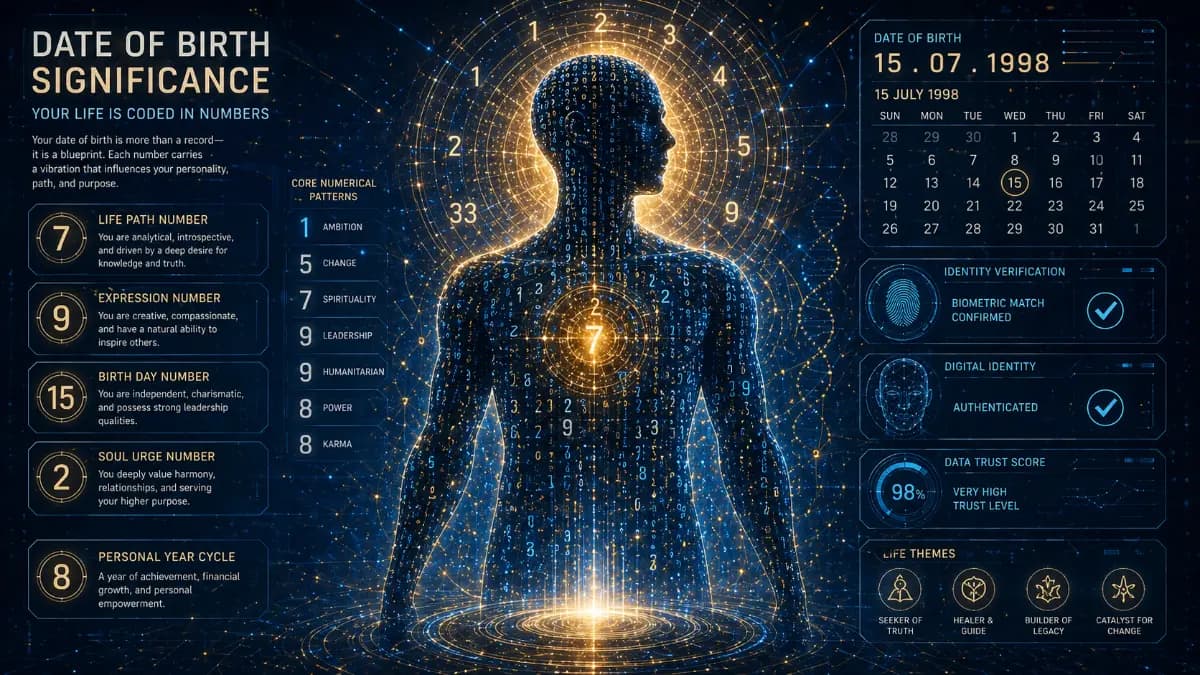
The Legal Mandate: Why Age Verification is Now Mandatory for Digital Life
The days of clicking a checkbox that reads "I confirm I am 18 or older" are effectively over. What once served as digital age verification — a self-reported tick box that anyone, at any age, could click without consequence — has been replaced by enforceable standards backed by real legal penalties.
From Honor System to Hard Enforcement
This shift didn't happen overnight, but 2026 marks the year the pressure reached a tipping point. The UK's Online Safety Act requires platforms to implement robust, technically reliable age verification systems — not suggestions, not checkboxes. Platforms that fail to comply face fines of up to 10% of global annual turnover. Across the Atlantic, laws like Texas HB 1181 mandate that websites hosting adult content verify users' ages using government-issued ID or third-party verification services before granting access.
Age Verification : A legally enforceable process requiring platforms to confirm a user's actual age through reliable technical means, rather than self-declaration.
The ripple effect extends far beyond adult content sites. Social platforms, gaming networks, health services, and financial tools are all reassessing their onboarding flows. A common pattern is that platforms previously comfortable with a "month/year of birth" dropdown are now required to collect and validate precise birth dates.
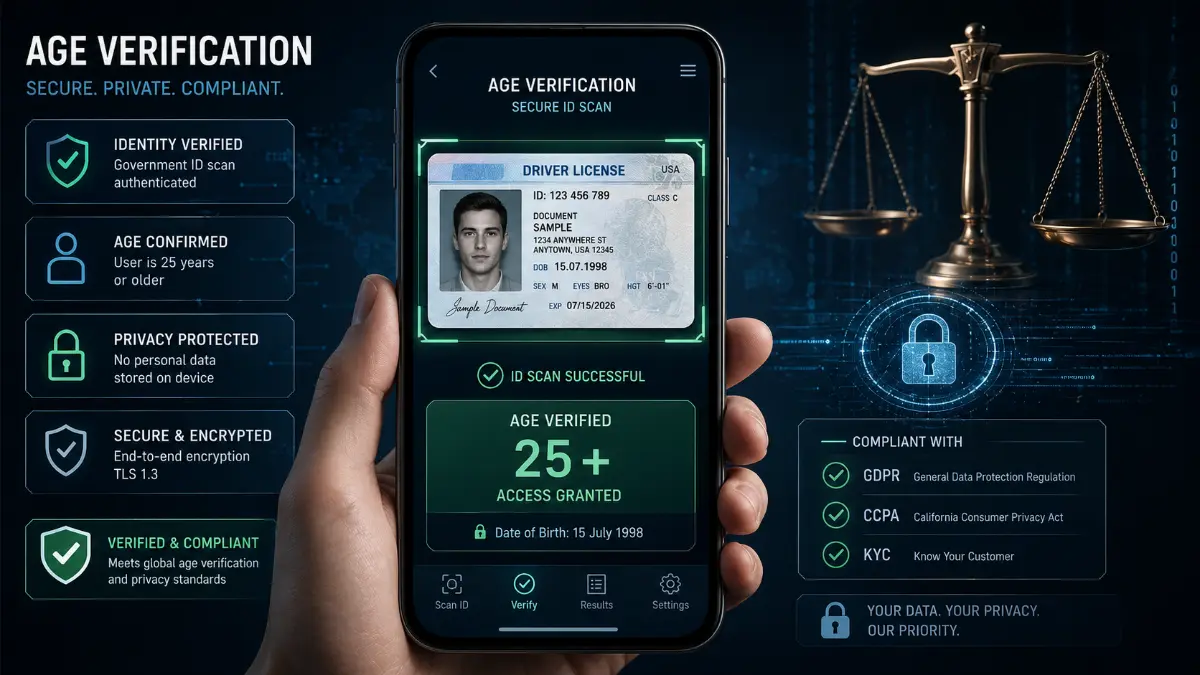
How Platforms Are Responding
Discord and Reddit — two platforms with massive under-18 user bases — have moved toward stricter date-of-birth collection paired with behavioral and technical verification layers. The precision matters: knowing a user was born in "1998" is no longer sufficient when legislation demands verifiable confirmation of whether someone has crossed a specific age threshold on a specific date.
This is where a date of birth calculator becomes more than a convenience — it becomes a compliance tool. Platforms need to calculate exact ages in real time, accounting for time zones, leap years, and jurisdiction-specific definitions of legal age.
The Privacy-First Alternative
Not every user wants to hand over government ID to browse a forum. The AgeCalc approach addresses this tension directly: calculate and confirm your age locally, without transmitting sensitive personal data to third parties. It's the kind of privacy-first architecture that satisfies both user concerns and the spirit of data-minimization principles embedded in modern privacy law.
As verification requirements grow stricter, the tools that balance precision with privacy will define how people navigate digital life — a reality that extends well beyond browsing habits and into some of life's most consequential decisions, including retirement planning and financial eligibility.
The Retirement Peak: Navigating the Social Security Shift of 2026
2026 marks a pivotal threshold in American retirement history. For workers born in 1960, Full Retirement Age (FRA) — the age at which you qualify for 100% of your Social Security benefit — officially reaches 67 years old. This completes a decades-long phase-in that began with the Social Security Amendments of 1983, and it arrives at exactly the moment when the retirement math becomes most consequential for millions of Americans.
Full Retirement Age (FRA) : The age defined by the Social Security Administration at which a worker becomes eligible to receive their complete, unreduced monthly benefit — currently 67 for anyone born in 1960 or later
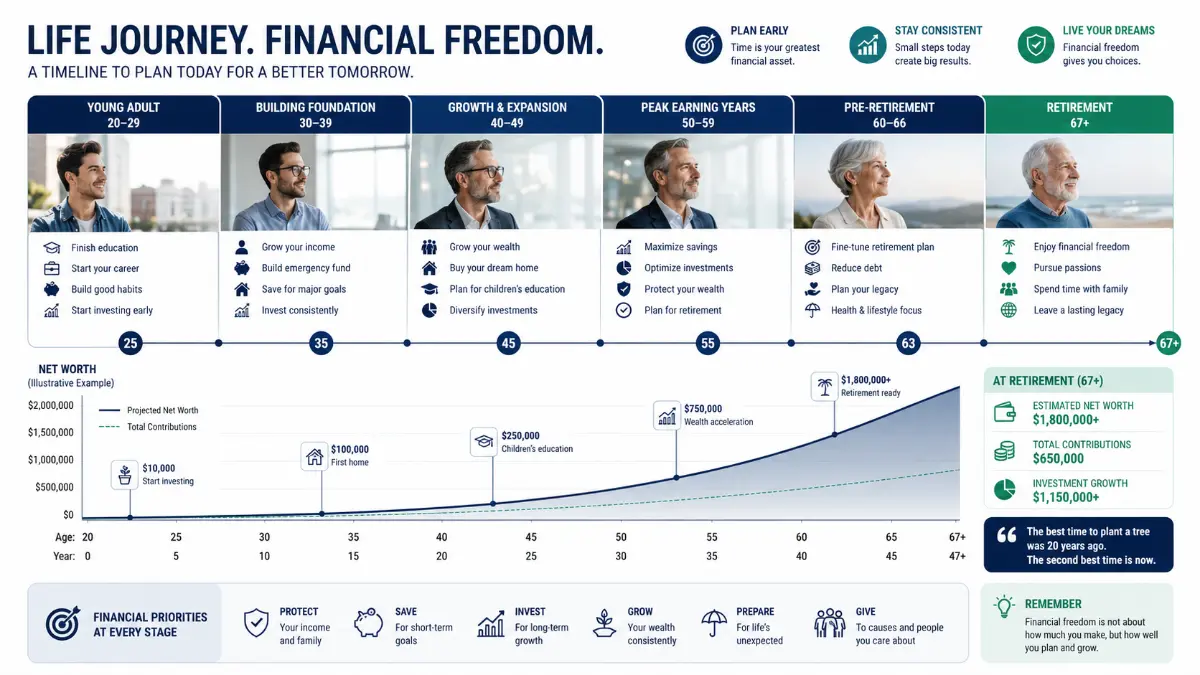
The Break-Even Problem No One Talks About
Claiming early at 62 versus waiting until 67 — or even 70 — isn't a simple decision. It's a break-even calculation that depends entirely on your precise date of birth, your expected lifespan, and the compounding difference between reduced early payments and delayed higher ones. A reliable birth date calculator gives you the exact age data you need to model these scenarios with accuracy, down to the month. Even a six-month miscalculation in your projected claim date can cost thousands of dollars in lifetime benefits.
The break-even point — the age at which delayed claiming finally outpaces early claiming in total dollars received — typically falls between ages 78 and 82, depending on individual circumstances. Knowing precisely where you stand relative to those numbers isn't optional anymore. It's financially critical.
The Baby Boomer 80th Birthday Milestone
On January 1, 2026, the first wave of Baby Boomers — those born on January 1, 1946 — turns 80 years old. This demographic landmark signals a surge in demand for estate planning, Medicare supplemental coverage, long-term care coordination, and senior benefits enrollment. Financial advisors and elder law attorneys are already reporting increased client urgency around this milestone.
Precise age tracking directly impacts estate management triggers, trust distribution schedules, and eligibility windows for age-gated senior services. Even a single day's difference in a recorded birth date can affect benefit disbursement timing.
The same precision that governs retirement benefits also shapes something more personal — your biological timeline. And as the next section reveals, science now has a startlingly specific map of what your birth date means for your body.
Biological Milestones: Using Your DOB to Track Aging 'Peaks'
Beyond retirement thresholds and legal mandates, your date of birth carries a deeper biological significance — one that cutting-edge science is only beginning to map with precision.
The Stanford Discovery That Changed How We Think About Aging
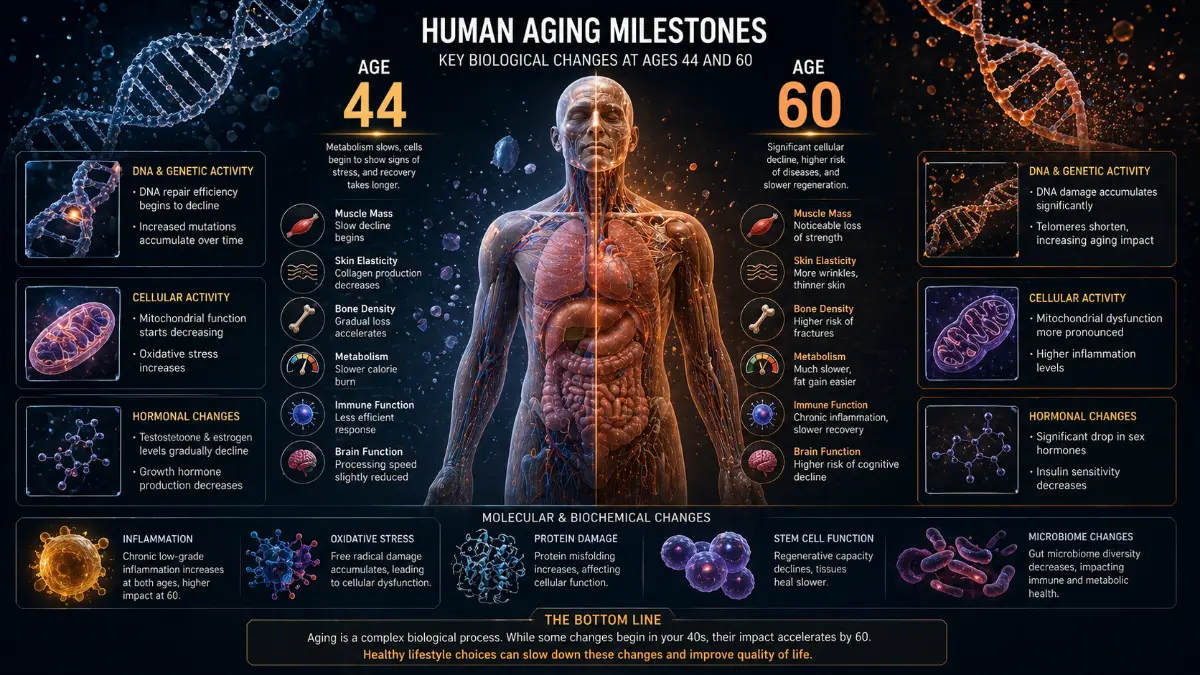
Researchers at Stanford University identified something remarkable: the human body doesn't age in a slow, continuous decline. Instead, it ages in molecular surges — dramatic, measurable shifts in proteins, lipids, and metabolites that cluster around specific ages. Two peaks stood out clearly: age 44 and age 60.
Molecular aging peak : A period of accelerated biological change during which hundreds of molecules in the body shift simultaneously, altering metabolism, immune function, and cardiovascular health in ways that standard annual checkups rarely capture.
At 44, the body shows significant changes in lipid metabolism and cardiovascular markers — even in people who appear outwardly healthy. At 60, a second, broader wave hits, affecting immune regulation, carbohydrate processing, and musculoskeletal function. These aren't gradual transitions. They're biological turning points.
Your DOB Calculator as a Biological Clock
This is where a DOB calculator becomes more than a novelty tool. By entering your exact date of birth, you can calculate precisely how far you are from either peak — not in vague years, but in months and days. Knowing you're 14 months from your 44th birthday, for example, creates a concrete, actionable window.
In practice, healthcare providers increasingly recommend using age-tracking tools like the Age Calculator at Calculator.net to time preventive screenings more strategically. Rather than relying on decade-based checkups, patients can align lipid panels, metabolic tests, and cardiovascular assessments with their actual proximity to these biological thresholds.
Personalized Nutrition and Screening, Timed to Your Biology
The implications extend into daily life. Nutritional needs shift meaningfully around both peaks — protein metabolism, vitamin D absorption, and inflammatory response all change. Functional medicine practitioners use precise chronological age data to customize supplementation timelines and dietary pivots.
The DOB calculator, in this context, functions as a biological clock —translating your birthdate into a roadmap of when to act, test, and adjust. It's proactive health management built on a foundation of exact timing rather than generalized age brackets.
As medical science grows more personalized, your date of birth becomes one of the most powerful data points you own. And as the next section reveals, some belief systems take that idea even further — treating 2026 itself as a numerologically charged year that amplifies the significance of specific birth dates.
Universal Year 1: The Numerology and Astrology of 2026
Not everyone approaching 2026 is thinking in terms of retirement cliffs or biological peaks. A significant and growing segment of people are reading this year through an entirely different lens — numerology and astrology — and what they're seeing is arguably the most energetically charged year in nearly a decade.
What Is a "Universal Year 1"?
Universal Year 1 : A single-digit value derived by reducing the current calendar year to its numerological root, believed to set the collective energetic theme for all humanity that year.
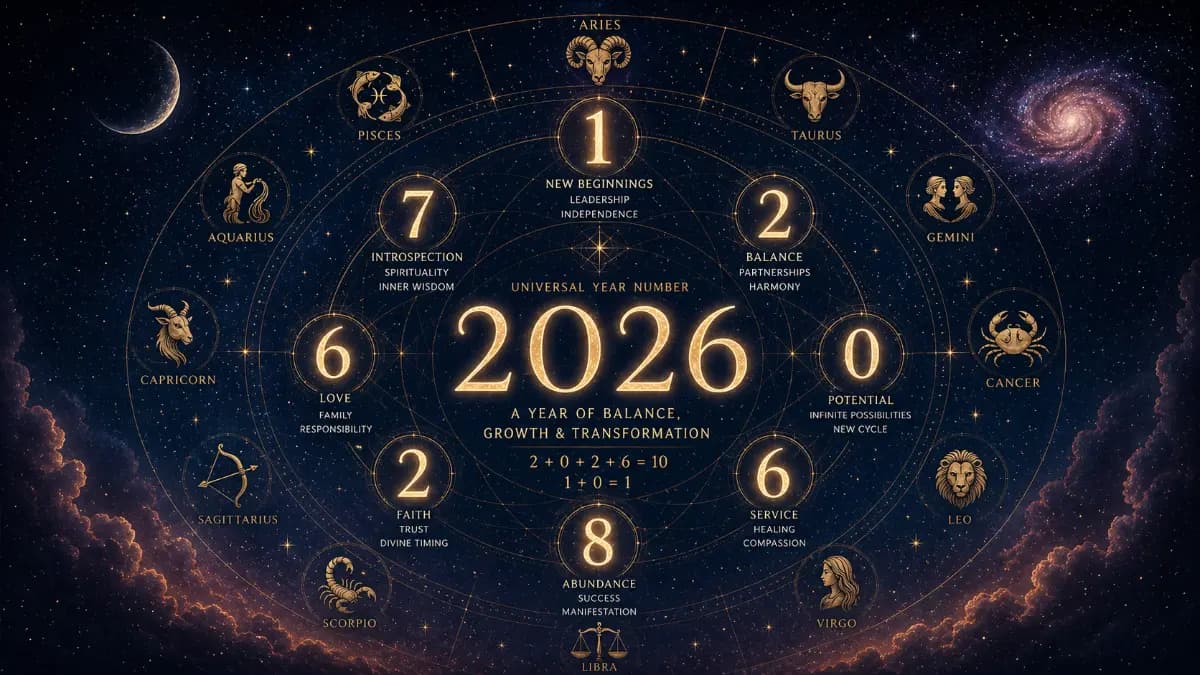
The math is simple: 2 + 0 + 2 + 6 = 10, and 10 reduces to 1. That makes 2026 a Universal Year 1 — often called The Sun's Year in numerological tradition. In practice, Universal Year 1 cycles signal collective beginnings, bold reinvention, and the end of old paradigms. It's not a year for coasting. It's a year for launching.
This framing matters beyond metaphysics. Millions of people use numerological calendars to time major decisions — starting businesses, relocating, or committing to relationships. A Universal Year 1 functions as a cultural permission slip to act.
Calculating Your Personal Year Number
While the Universal Year sets the backdrop, your Personal Year Number personalizes that energy through your date of birth.
The formula: add your birth day + birth month to the Universal Year number (1).
- Example scenario: Born on 07/14 → 7 + 1 + 4 + 1 = 13 → 1 + 3 = Personal Year 4 (stability, foundation-building)
- Born on 03/09 → 3 + 9 + 1 = 13 → Personal Year 4 as well
Your Personal Year number shifts your experience of 2026 dramatically. A Personal Year 1 (mirroring the Universal Year) is considered the most potent alignment possible — a rare "double activation" that numerologists associate with breakthrough moments.
The Power Shift: 5 Birth Dates in 2026's Spotlight
Trending numerology content in 2026 has zeroed in on five specific birth date patterns where the Personal Year calculation produces a double-1 alignment: those with birth month + day combinations summing to 8 (since 8 + 1 = 9… wait — or summing to 9, reducing to 9+1=10=1). Birth dates landing on 09/09, 03/15, 06/12, 01/17, and 08/10 are frequently cited as carrying amplified "activation codes" this year.
This is precisely why birth chart calculator tools have surged in popularity — users want to cross-reference their numerological Personal Year with their full astrological profile. When a Personal Year 1 aligns with favorable solar transits in a natal chart, practitioners consider that a "personal activation year" rather than a routine calendar turn.
Why 2026 Feels Different
2026 is not a passive year — it's a trigger year, where your date of birth becomes the key that either unlocks or delays your next chapter. Whether you treat that framing literally or use it as motivational scaffolding, the practical result is the same: more people than ever are punching their DOB into calculators and asking deeper questions about what this particular year means for them specifically.
That instinct to personalize 2026 — whether through numerology, biology, or retirement math — connects to a broader cultural phenomenon worth examining. And as it turns out, 2026 holds one more universally shared curiosity: a viral math trick that bridges every generation, from newborns entering the world as Generation Beta to centenarians marking a century of life.
The 2026 Math Trick and the Next Generation
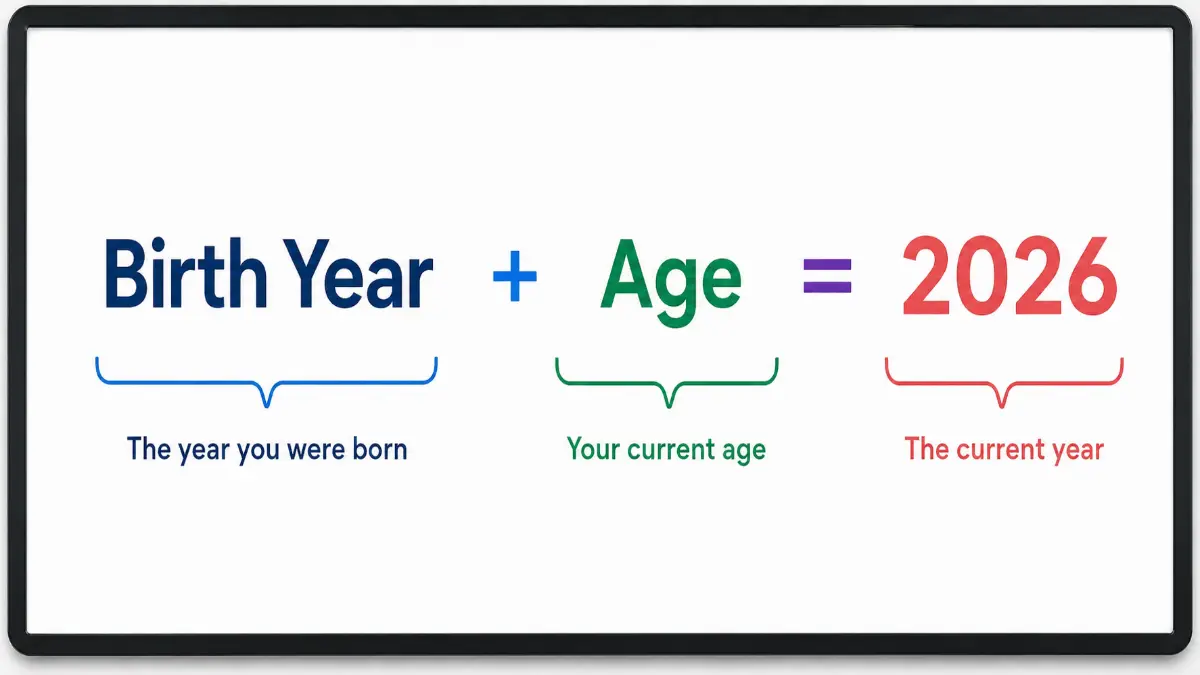
Here's the viral 2026 math trick that's lighting up social media: in 2026, every single person on Earth will find that their birth year plus their current age equals exactly 2026. Born in 1990? You're turning 36. Born in 2001? You're turning 25. The math works universally, making 2026 a genuinely rare calendar curiosity — and a perfect excuse for millions of people to reach for a date of birth calculator to verify it themselves.
Generation Beta and the Next Wave
Babies born in 2026 will be the newest members of Generation Beta — the cohort following Generation Alpha (born 2013–2025). These children will inherit an AI-native world, and parents expecting 2026 births are already treating the birth date itself as a strategic decision. In many South Asian communities, the concept of shubh muhurat — an auspicious birth window determined by astrological alignment — is driving significant demand for birth chart calculators that map planetary positions against specific dates. What was once a practice reserved for astrologers is now accessible through digital tools, blending ancient tradition with modern convenience.
The DOB Calculator: 2026's Swiss Army Knife
From retirement planning to biological milestones, numerological forecasting to generational identity, the date of birth calculator has become an essential tool. It answers questions no single government form, doctor's office, or horoscope column can answer alone.
Key Takeaways:
- The 2026 math trick applies to every living person — universally
- Generation Beta begins with 2026 births
- DOB calculators serve legal, biological, spiritual, and cultural needs simultaneously
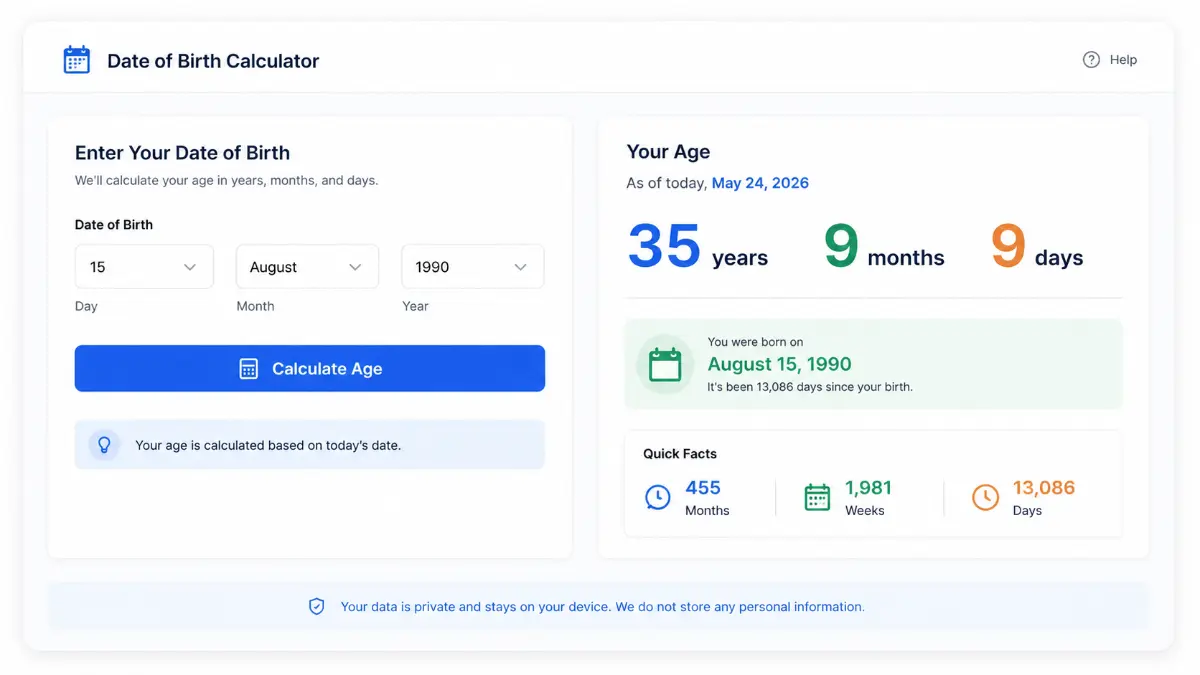
Your date of birth has never carried more weight. Use a reliable age calculator to understand exactly what 2026 means for yours.
Related articles
Keep reading similar topics
Precise Age Calculator: Calculate Chronological Age Instantly
Need an accurate age calculation? Use our professional age calculator to determine your precise chronological age for legal, personal, and official milestones.
Age Calculator: Discover Your Biological Clock & Real Age
Go beyond the calendar. Use our precise date of birth calculator to reveal your exact age in seconds and gain deeper insights into your biological clock today.
Precise Age Calculator: Calculate Age by Years, Months, Days
Need an exact age calculation? Use our professional age calculator to determine chronological age in years, months, and days for legal and clinical accuracy.