

Precise Age Calculator: Calculate Age by Years, Months, Days
Table of Contents
The Ultimate Age Calculator: How to Calculate Chronological Age with Precision
A birthday marks a single moment in time. Chronological age, however, is something far more precise — it is the exact measure of time elapsed between the date of birth and any given reference date, expressed in years, months, and days. This distinction matters enormously in contexts where a rough estimate simply will not do.
Whether you are a healthcare professional conducting a developmental assessment, a legal practitioner verifying eligibility, or a parent navigating school admission deadlines, the difference between "turning six this year" and "aged 5 years, 11 months, and 14 days" can be consequential. An age calculator eliminates the ambiguity that creeps into manual date subtraction — particularly when month lengths vary and calendar borrowing is involved.
Chronological Age: The precise measurement of elapsed time from a person's date of birth to a specific reference date, calculated in years, months, and days rather than whole years alone.
Why Manual Calculation Falls Short
Traditional date subtraction is surprisingly error-prone. Calculating across months with different lengths — February's 28 or 29 days, the 30-day months, the 31-day months — introduces complexity that grows with each calculation performed under time pressure. In clinical and legal settings, even a single day's error can shift an individual into a different eligibility category, a different developmental percentile, or a different legal jurisdiction.
Automated tools now serve as the standard-bearer for this task. A reliable current age calculator provides an immediate, verifiable result that withstands professional scrutiny — from school admissions panels to asylum age assessments, as noted in the EUAA's Practical Guide on Age Assessment.

What This Guide Covers
This definitive guide explores chronological age calculation from every relevant angle: the mechanics of precise date arithmetic, the legal frameworks that depend upon it across different jurisdictions, and the cultural nuances that shape how age is counted around the world.
Understanding exactly how a chronological age calculator arrives at its output — and why that method matters — is where we begin.
What is a Chronological Age Calculator?
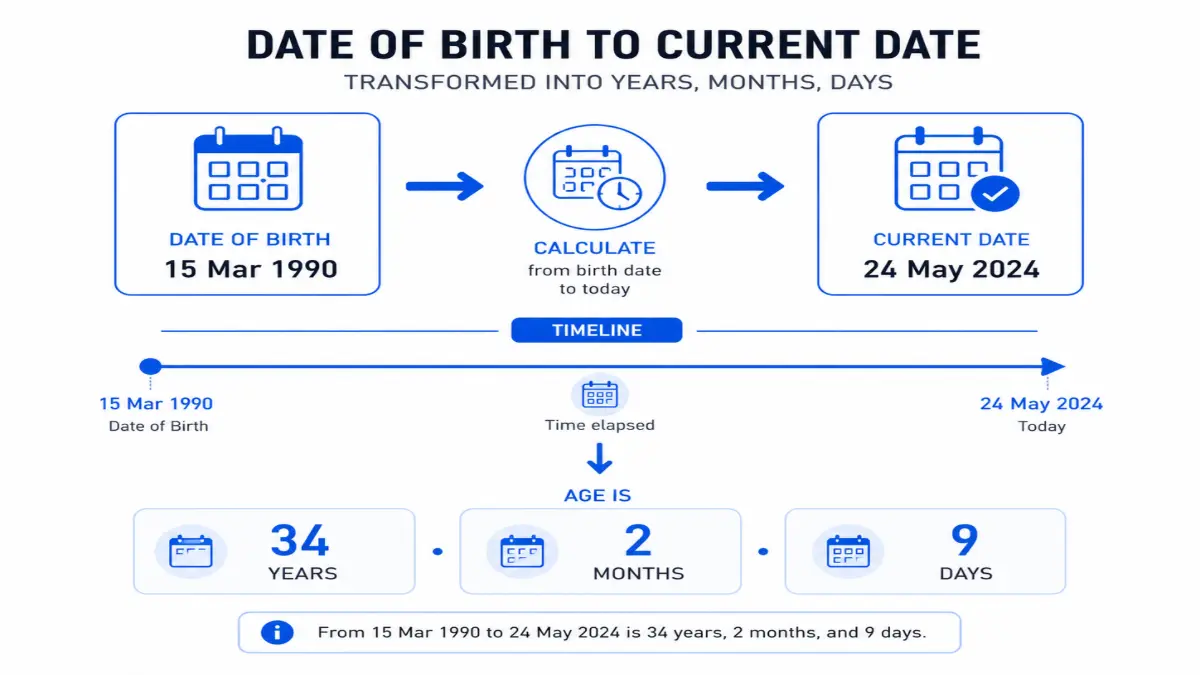
A chronological age calculator is a structured tool designed to determine a person's precise age by breaking time down into its three constituent components: years, months, and days. Rather than simply subtracting a birth year from the current year — a method that introduces inaccuracy — a proper calculator measures the exact elapsed time between a date of birth and any chosen reference date.
The Year/Month/Day Breakdown
The output of a chronological age calculation is expressed in a standardised format: X years, Y months, Z days. This granular breakdown matters enormously in professional contexts. A child assessed as "6 years old" might be anywhere from 6 years and 0 days to 6 years and 364 days old — a developmental difference of nearly a full year that generic rounding entirely obscures.
Chronological Age: The precise measure of time elapsed since birth, expressed in years, months, and days, used as a baseline for developmental, clinical, and legal assessments.
To calculate age with this level of precision, most calculators follow a logical sequence: first determine the number of complete years elapsed, then count remaining months, and finally tally remaining days.
The Borrowing Method Explained
When the current day or month is less than the birth day or month, the calculation requires what practitioners call the borrowing method — similar in logic to borrowing in subtraction arithmetic.
Example scenario: A person born on 15/08/1990 is assessed on 03/04/2025. Since April (month 4) is less than August (month 8), the calculator must "borrow" a year and add 12 months to the current month before subtracting. Similarly, if the current day falls before the birth day, one month is borrowed and its equivalent number of days added. This cascading adjustment ensures the result reflects genuinely completed time periods rather than approximate figures.
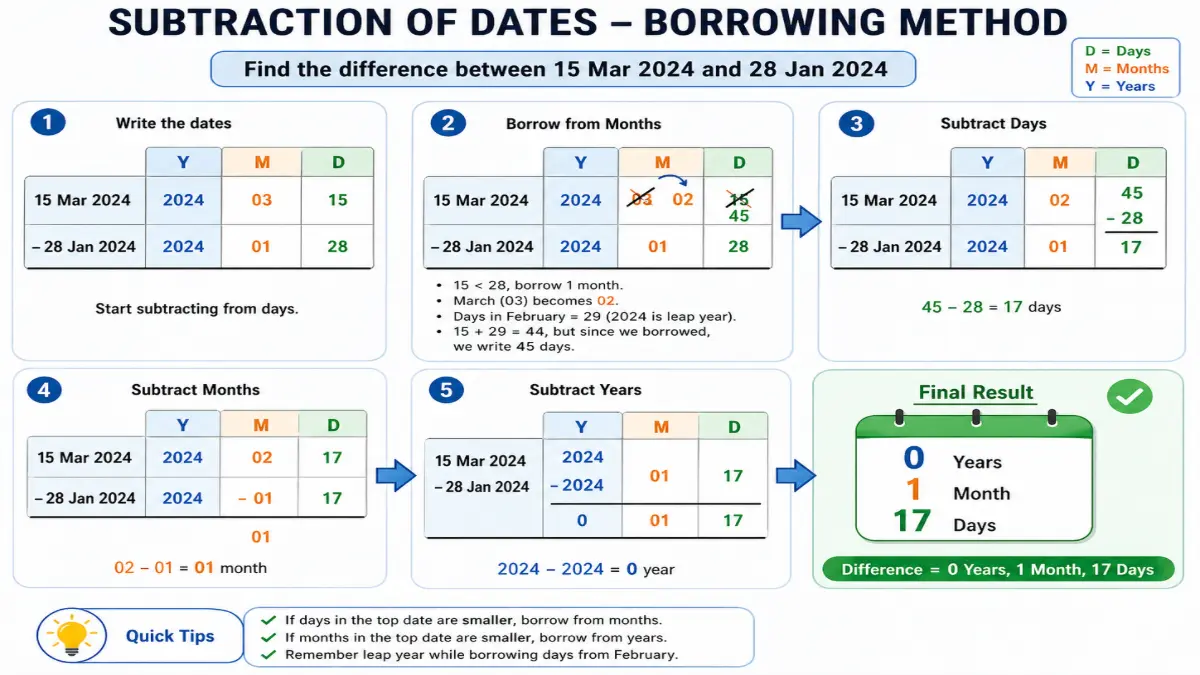
In practice, this method is the standard approach outlined in clinical and educational assessment guides, including frameworks used in Pearson-style psychometric evaluations, where an error of even a single month can shift a child into a different normative scoring group.
Current Age Versus Age at a Specific Date
A further distinction that frequently causes confusion is the difference between current age (calculated to today's date) and age at a specific past or future date. These are not interchangeable. Legal eligibility checks, retrospective clinical records, and benefit entitlement assessments all require age calculated to a defined reference date, not today.
On the other hand, developmental screenings and school admissions typically need current age, accurate to the day. Conflating these two use cases is a common error with real administrative consequences.
Understanding precisely how these calculations operate under the hood — including how different calendar systems and software tools handle them — is where the complexity deepens considerably.
The Mechanics of Age Calculation: From Date of Birth to Time Duration
Understanding how an age calculator actually works — beneath the simple interface — reveals a surprisingly nuanced set of decisions. Every reliable age calc tool must resolve several technical challenges before it can deliver a precise result, and knowing these mechanics helps you trust the output you receive.
Time Duration in Years Versus Total Days Lived
The most fundamental choice in any calculation is which unit of time to report. Total days lived is mathematically straightforward: subtract the date of birth from today's date and count the resulting days. However, a lifespan expressed as "14,610 days" is far less intuitive than "40 years, 0 months, 0 days."
Time Duration in Years: The expression of elapsed life as whole calendar years, with remaining months and days reported separately — the standard format used in medicine, law, and education.
Converting raw days into years introduces real complexity. Calendar years are not uniform; they contain either 365 or 366 days depending on whether a leap year is involved. A precise calculation must account for every leap year that falls within the period being measured, rather than simply dividing total days by 365.25.
Input Validation: Why a Date of Birth Calculator Must Check Its Data
A date of birth calculator is only as reliable as the inputs it accepts. Robust tools enforce strict input validation before any calculation begins. This means:
- Format consistency — the tool must interpret DD/MM/YYYY correctly, especially important for UK users where the day precedes the month
- Logical date checks — rejecting impossible dates such as 30th February or 31st November
- Future date handling — flagging a date of birth that falls after today's date as invalid
- Range limits — sensible upper boundaries prevent errors from clearly erroneous entries
Without these checks, a single malformed input can produce a wildly inaccurate result — or no result at all.
Calendar Systems and the Gregorian Standard
Most digital tools default to the Gregorian calendar, the internationally adopted civil standard. However, certain professional and cultural contexts require awareness of alternative systems, including the Julian calendar (relevant for historical age calculations) and lunisolar calendars used across parts of Asia. A well-designed tool will explicitly state which calendar system underpins its output.
The Complexity of Age Calculation in Software Like Excel
Practitioners who build age calculations in spreadsheet software quickly discover that Excel's handling of dates is deceptively fragile. The DATEDIF function — whilst widely used — is an undocumented legacy function that Microsoft itself no longer actively supports. A common pattern is for users to combine YEARFRAC, INT, and DATE functions to achieve reliable year-month-day breakdowns, though even these approaches require careful testing around month-end edge cases.
Precision in age calculation is not a given — it is engineered through deliberate design choices at every stage of the process.These technical foundations become even more consequential when legal standards enter the picture. As the next section explores, how a jurisdiction defines the moment a new year of life begins can vary significantly — with real consequences for birthdays that fall on dates the calendar does not always recognise.
Legal and Cultural Nuances: Leap Years and Global Standards
Age calculation is rarely as straightforward as subtracting one year from another. Across different legal systems and cultural traditions, the same birthdate can yield a meaningfully different "official" age — with real consequences for rights, entitlements, and identity. Understanding these nuances is essential context before exploring how age precision shapes insurance, education, and legal outcomes in practice.

The Curious Case of Leaplings
Leapling: A person born on 29th February, whose birthdate exists only in leap years, occurring once every four years.
In the UK, a leapling legally turns a given age on 28th February in non-leap years. This convention, rooted in common law, means a child born on 29th February 2008 would have been considered legally 16 on 28th February 2024 — not 29th February — for purposes such as school leaving age or driving eligibility. New Zealand follows a similar approach, enshrining 28th February as the recognised anniversary when the leap date does not exist. The practical effect is that leaplings' rights and responsibilities activate one day earlier than their literal birthdate might suggest.

UK vs. US Government Standards
The divergence doesn't stop at leap years. In the UK, the standard convention for age calculation treats the day before a birthday as the moment a person legally "turns" a new age — a principle sometimes called the "eve of birthday" rule.
By contrast, US government frameworks, including elapsed-time standards used in federal programme administration, typically calculate age based on the number of complete years that have passed since birth, measured precisely to the day. This creates edge-case differences that, whilst they may seem academic, carry weight in contexts such as federal benefits eligibility or military service age verification.
Precision in age calculation is not merely mathematical — it is jurisdictional.South Korea's 2023 Age System Reform
One of the most significant recent shifts in global age standards occurred in South Korea in June 2023, when the country formally transitioned to the international age system for all official and legal purposes. Previously, South Korea used a unique system in which everyone aged up collectively on 1st January each year — meaning a baby born on 31st December was considered "two" just two days later.
This reform aligned South Korea with international norms and eliminated widespread confusion around medical dosing, contract eligibility, and governmental administration. It is a landmark example of how cultural age reckoning and legal age standards can diverge significantly.
Traditional East Asian Age Reckoning
The South Korean reform also shone a light on East Asian age reckoning, a tradition shared across Korea, China, Japan, and Vietnam, in which a person is considered one year old at birth — reflecting the months spent in the womb. Under this system, a person born in December could technically be "two" before their first birthday by the Western calendar.
Whilst this tradition carries deep cultural meaning, it creates practical complexity in any cross-border or modern administrative context where standardised age calculation is required.
These global contrasts set the stage for understanding exactly why precise, system-aware age calculation matters — whether you're navigating an insurance application, a school enrolment form, or a legal threshold. The next section explores those real-world stakes in depth.
Why Precision Matters: Use Cases for Age Calculation
Knowing someone's exact age is rarely a trivial exercise. As earlier sections have shown, leap years, cultural conventions, and legal jurisdictions all introduce variability into what seems like a simple subtraction. In practice, that variability carries real consequences — financial, educational, legal, and historical. A reliable date of birth calculator removes ambiguity precisely when the stakes are highest.

Insurance: Premiums, Eligibility, and Exact Age Bands
Insurance pricing is acutely sensitive to age. Life and health insurers routinely use age banding — grouping policyholders into defined age brackets — to set premiums, with rates often recalculated on the policy anniversary date nearest to the insured's birthday. A single day's difference can move a person into a higher premium band. Under programmes such as TRICARE, eligibility for specific coverage tiers is determined by precise chronological age thresholds. Errors in age recording therefore translate directly into incorrect premiums or wrongful denial of cover.
Education: School Entry and Developmental Milestones
School entry age: The minimum chronological age at which a child is legally permitted to begin compulsory schooling, typically calculated to the day against a statutory cut-off date.
In the United Kingdom, children must begin school in the term following their fifth birthday, though most local authorities admit children at four. Calculating whether a child falls before or after the admissions cut-off — often 31st August — requires day-accurate reckoning. Developmental assessments use the same principle, adjusting expected milestones against a child's precise date of birth rather than their year alone.
Legal: Statutory Thresholds That Cannot Afford Rounding
Legal systems treat age as a hard boundary. The age of criminal responsibility, the age of consent, eligibility to vote, and the state pension age (currently 66 in the UK, rising to 67 by 2028) all activate on a specific date, not a rough approximation. The EUAA's Practical Guide on Age Assessment underscores how consequential age disputes can be in asylum and immigration contexts, where miscalculation may determine whether an individual is treated as a minor or an adult under the law.
Imprecision in legal age calculation is not a minor administrative inconvenience — it is a potential miscarriage of rights.
Genealogy: Reconstructing Lives from Historical Records
For family historians, calculating age at death from baptismal and burial records reveals life expectancy patterns and helps verify identities across incomplete archives. Because historical records often list only a year of birth, genealogists must account for whether a birthday had passed in the year of death — a task that demands careful month-and-day comparison rather than simple year subtraction.
Common questions arise around these practical applications — including how modern tools handle historical dates and how to calculate age in months or days rather than years. Those specifics are addressed directly in the section that follows.
Frequently Asked Questions: Current Age and Simple Methods
What Is a Current Age Calculator?
A current age calculator is any tool — digital or manual — that automatically uses today's date as the endpoint for its calculation. Rather than requiring you to input both a start and end date, it defaults to the present moment, delivering an instant result. A chronological age calculator works on this same principle, measuring the precise span of time elapsed since a person's date of birth to the current date.
What Is the Simplest Method for Calculating Age?
The most straightforward approach is year subtraction with a month and day check:
- Subtract the birth year from the current year
- If the birthday has not yet occurred this calendar year, subtract one additional year
Example scenario: A person born on 15/08/1990, checked on 01/03/2025, would calculate as 2025 − 1990 = 35, then minus one (birthday not yet passed) = 34 years old. This method works reliably for everyday purposes, though legal and medical contexts may demand greater precision, as explored throughout this guide.
Can Online Tools Calculate Age From a Historical Date?
Yes. Most digital calculators allow you to set a custom reference date rather than defaulting to today. This is particularly useful for historical research, legal retrospective assessments, or verifying someone's age at a specific past event.
How Do I Calculate Age in Months or Days Only?
- In months: Multiply completed years by 12, then add remaining full months
- In days: Count the total number of days between the birth date and the reference date, accounting for leap years
Age in days: The total elapsed days between two dates, including all leap-year adjustments — critical in neonatal care and early childhood developmental assessments.
Precision at this level matters most in paediatric medicine, educational placement, and benefit entitlement calculations.
Accurate age calculation is more than arithmetic — it is a legal, medical, and administrative cornerstone. Use a reliable chronological age calculator whenever precision is non-negotiable, and consult the deeper guides linked throughout this article for specialist applications.
Related articles
Keep reading similar topics
Precise Age Calculator: Calculate Chronological Age Instantly
Need an accurate age calculation? Use our professional age calculator to determine your precise chronological age for legal, personal, and official milestones.
Age Calculator: Discover Your Biological Clock & Real Age
Go beyond the calendar. Use our precise date of birth calculator to reveal your exact age in seconds and gain deeper insights into your biological clock today.
Age Calculator Verify Your DOB & Birth Date Instantly
Need to confirm your exact age? Use our reliable DOB calculator for instant, accurate results. Perfect for age verification, numerology, and birth chart math.