

Professional AI Grammar Checker | Perfect Your English Writing
Table of Contents
Beyond the Red Squiggle: Why AI Grammar Checkers Are the New Standard for Professional English
Elevate your writing with our advanced AI grammar checker. Fix errors, refine your tone, and polish your professional English with the ultimate sentence editor.
The Evolution of the Sentence Corrector: From Spellcheck to AI
Cast your mind back to the late 1990s, when a wavy red line beneath a misspelled word felt like genuine technological wizardry. Today, that same red squiggle looks almost quaint. The modern grammar checker does something far more sophisticated — it understands context, tone, intent, and the subtle mechanics of professional English in real time.
From Dictionary Lookups to Deep Language Understanding
Early spellcheck tools operated on a simple principle: compare each word against a stored dictionary and flag anything that doesn't match. Effective for typos, certainly — but fundamentally limited in scope. A sentence like "Their going to the meeting" would sail through without a single red squiggle, because every word exists in the dictionary. The error is grammatical, not orthographic, and that distinction is everything.
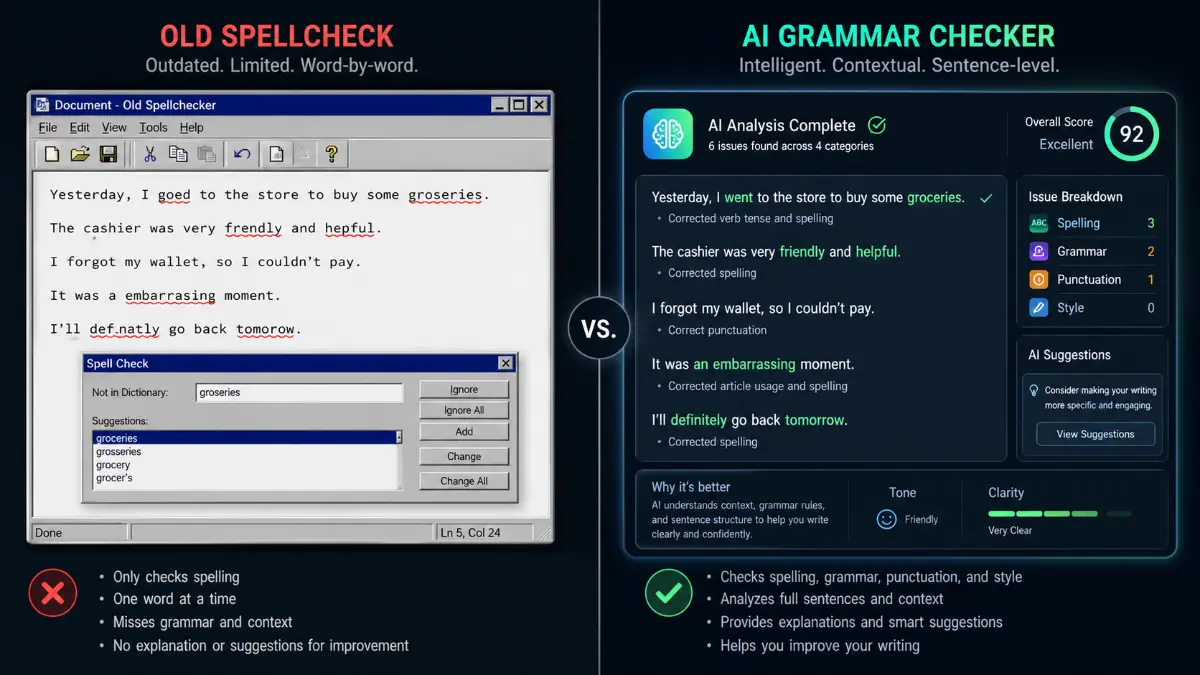
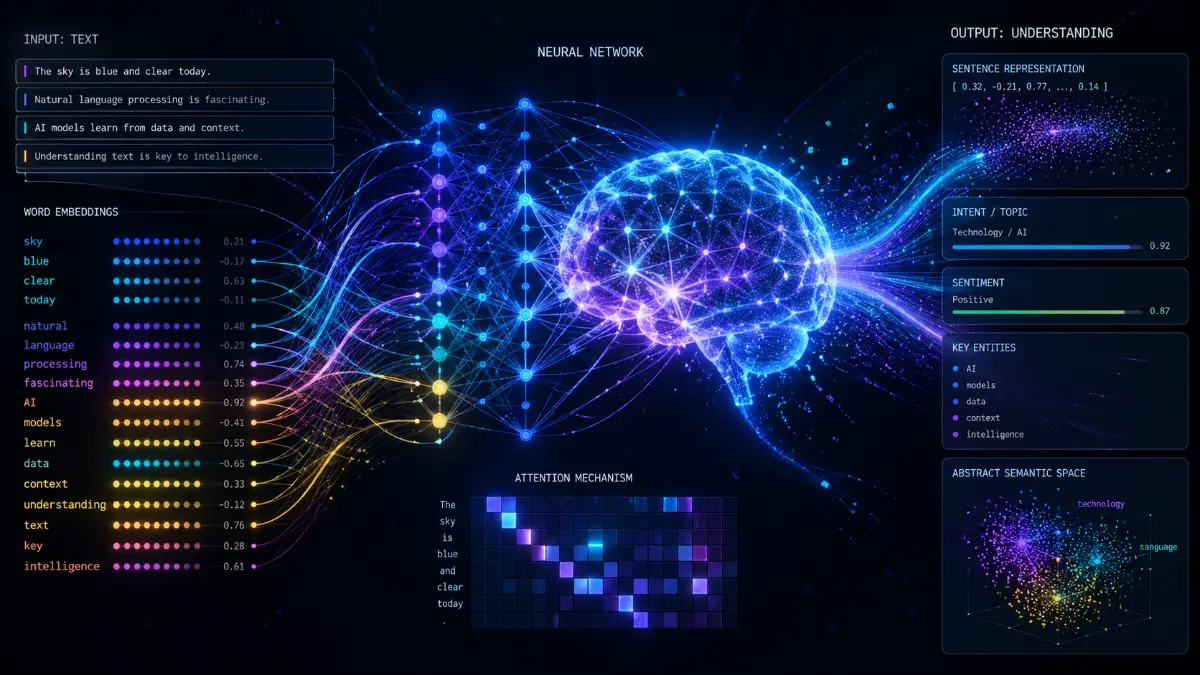
Natural Language Processing (NLP) changed the game entirely. By training on vast corpora of text, modern AI systems learn the probabilistic relationships between words, phrases, and sentence structures. According to research into automated writing assistance, the field has expanded dramatically beyond correction into style guidance, clarity scoring, and register-appropriate suggestions.
A Multi-Billion Pound Industry Built on a Universal Problem
Poor written communication costs businesses considerably — in lost contracts, misread proposals, and damaged professional credibility. This pressure has turned grammar checking into a thriving global market, with demand spanning students, executives, non-native speakers, and content professionals alike. In 2026, industry analysts estimate the grammar checking market to be worth over £2 billion, reflecting its critical role in professional communication.
Online grammar checker: A browser-accessible writing tool that applies AI-driven linguistic analysis to identify grammatical errors, stylistic weaknesses, and clarity issues without requiring software installation.
What's particularly significant is how AI has democratized professional-grade communication. The polished prose that once required a seasoned editor or copywriter is now accessible to anyone with an internet connection — leveling the playing field across industries and skill levels.
This shift has also reshaped how people access these tools. Increasingly, writers are bypassing account creation altogether in favour of instant, frictionless editing — and that behavioural change is reshaping the entire market.
The 'No Sign-Up' Revolution: Why Instant Online Editors are Winning
There's a specific kind of friction that kills productivity before it even begins: the account creation wall. You've drafted a quick email, a client proposal, or a social media caption, and you want a fast grammar check before you hit send. Then a pop-up demands your email address, a password, and consent to a marketing newsletter. Most writers simply close the tab.

This psychological barrier is more significant than it might appear. The extra 90 seconds of form-filling doesn't just delay your work — it actively interrupts your cognitive flow, pulling you out of writing mode and into administrative mode. For professionals who need to polish text quickly and move on, that friction is a genuine deterrent.
The Rise of the Browser-Based Editor
Browser-based editor: A writing tool that runs entirely within a web browser, requiring no software installation, account registration, or login to access core functionality.
This is precisely why browser-based editing tools have captured such a loyal following. Tools that allow users to paste text and receive instant suggestions — no registration required — remove the single biggest obstacle between a writer and better prose. The experience is immediate: open a tab, paste your text, receive feedback. Done.
Privacy is another compelling factor. When no account exists, no personal writing data is stored against a profile. For professionals handling sensitive client information, legal correspondence, or confidential business documents, this distinction matters enormously. Free AI grammar checker tools create a natural data boundary: your words are processed, suggestions are returned, and nothing is retained. This stands in meaningful contrast to subscription platforms, which may use your writing to inform their models over time — a concern the automated writing assistance landscape research has flagged as an emerging consideration for enterprise users.
Editor Mode vs. Plugin Mode: A Practical Distinction
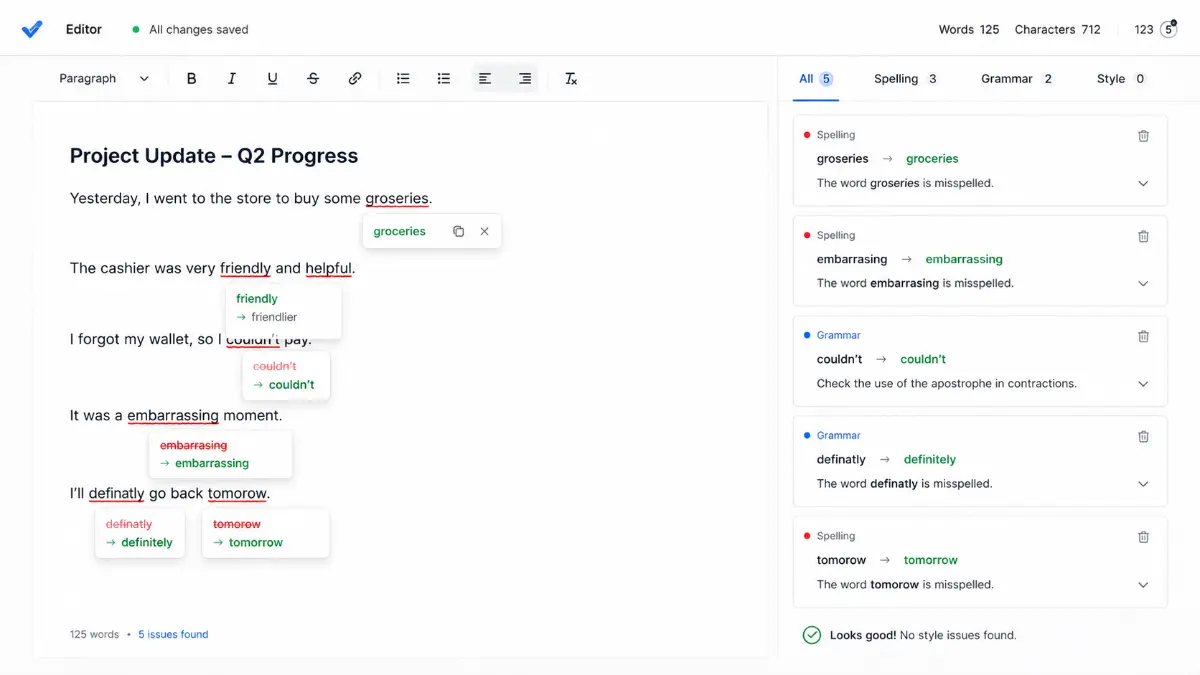
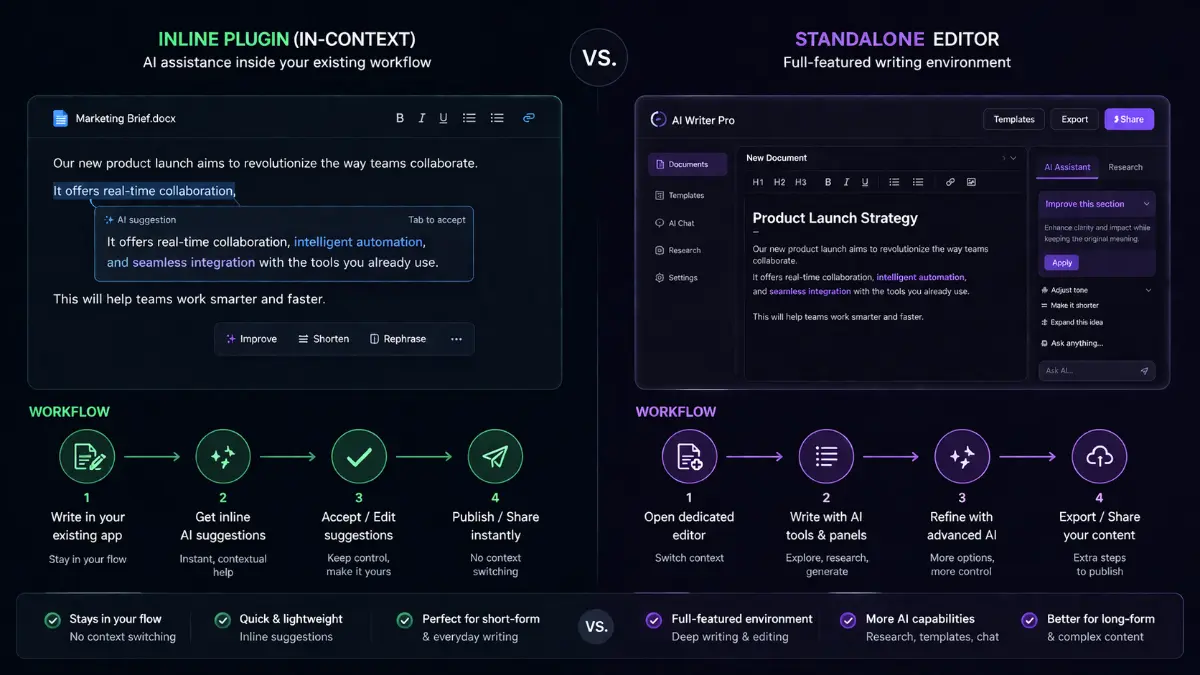
Once you've decided to use an AI writing tool, you face a secondary choice that significantly shapes your workflow: do you use a standalone web editor or an integrated plugin?
- Web editors suit writers who batch their edits — drafting in one application, then pasting into the tool for a focused review pass. The separation encourages deliberate editing rather than reactive, suggestion-by-suggestion tinkering.
- Plugins (browser extensions or word processor add-ons) embed suggestions directly into your writing environment, flagging issues in real time. They're convenient, but research into AI grammar checkers suggests inline suggestions can actually interrupt creative momentum, nudging writers to over-edit as they draft.
Neither approach is universally superior. In practice, the best writers tend to match the tool format to the task: plugins for routine correspondence, standalone editors for considered, high-stakes writing.
The question of which specific tools the writing community actually trusts for each of these scenarios is worth examining in depth — and that's precisely where real-world writer consensus becomes invaluable.
What Do Real Writers Actually Use? The Reddit Consensus
The online writing community has strong opinions about grammar checkers — and nowhere is that more apparent than in the sprawling, candid discussions on r/writing, r/freelancewriting, and r/grammar. Strip away the marketing copy and the polished testimonials, and a genuinely useful picture emerges of how working writers actually navigate automated assistance.
The 'Stack' Mentality
One pattern surfaces repeatedly in community threads: professional writers rarely rely on a single tool. Instead, they build a writing tool stack — a layered combination of resources that compensates for each individual tool's blind spots.
Writing tool stack: A curated combination of two or more automated writing aids used in sequence, where each tool addresses the limitations left by the others.
A common configuration involves using a fast, no-sign-up sentence corrector for quick structural passes, then layering in a more contextual AI tool for tone and style suggestions before a final human read-through. The logic is straightforward: no single piece of software catches everything. A tool that excels at flagging passive constructions may miss an ambiguous pronoun reference entirely, while another that brilliantly untangles complex syntax might over-flag intentional fragments used for dramatic effect.
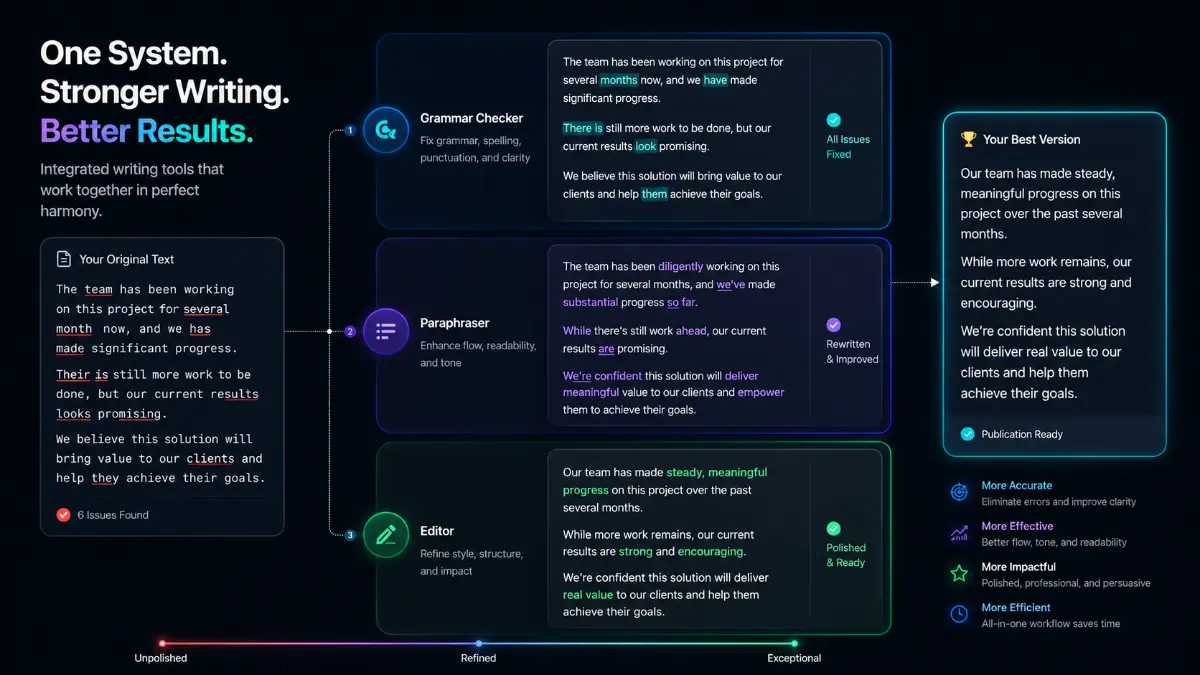
This collaborative, multi-tool approach reflects a broader shift in how serious writers think about automation — not as a replacement for craft, but as a series of intelligent filters. According to research into automated writing assistance, the landscape has fragmented into specialised tools rather than converging on a single dominant solution, which validates precisely why the stacking approach has gained traction.
The 'Human in the Loop' Philosophy
Perhaps the most consistent theme across community discussions — and one that separates confident writers from anxious ones — is the human-in-the-loop philosophy.
Human in the loop: The principle that automated suggestions are starting points for editorial judgement, not binding corrections. The writer retains final authority over every change.
This matters enormously in practice. AI grammar checkers are trained on vast corpora of published text, which means they can inadvertently flag stylistic choices that are entirely intentional. A fragmented sentence for emphasis. A comma splice for breathless pacing. As analysis of AI grammar checkers notes, tools routinely challenge perfectly natural stylistic decisions simply because they fall outside statistical norms.
The most respected voices in writing communities are consistent on this point: suggestions are data, not directives. Accepting every AI recommendation wholesale is a reliable route to generic, flattened prose that sounds like it was written by committee.
The takeaway is not to distrust these tools — it's to use them with calibrated confidence. Understanding when to accept a correction, when to dismiss it, and when to rethink the underlying sentence entirely is a skill in itself.
This balance between automation and human judgement carries tangible implications beyond individual craft, and it's a distinction that forward-thinking organisations are beginning to quantify in measurable business terms.
The Business Case: Measuring the ROI of Automated Writing Assistance
Grammar tools are no longer just a convenience for individual writers — they're a measurable business asset. As organisations increasingly recognise the commercial cost of poor written communication, the conversation has shifted from "should we use these tools?" to "how much are we losing by not using them?"
Quantifying Time Saved: Minutes Matter at Scale
The most immediate return on investment is time. A professional who manually proofreads a 1,000-word report might spend 20 to 30 minutes checking for errors in grammar, punctuation, and consistency. An AI-powered english grammar check tool performs the same scan in seconds — flagging not just surface-level typos but contextual misuse, tone inconsistencies, and structural weaknesses simultaneously.
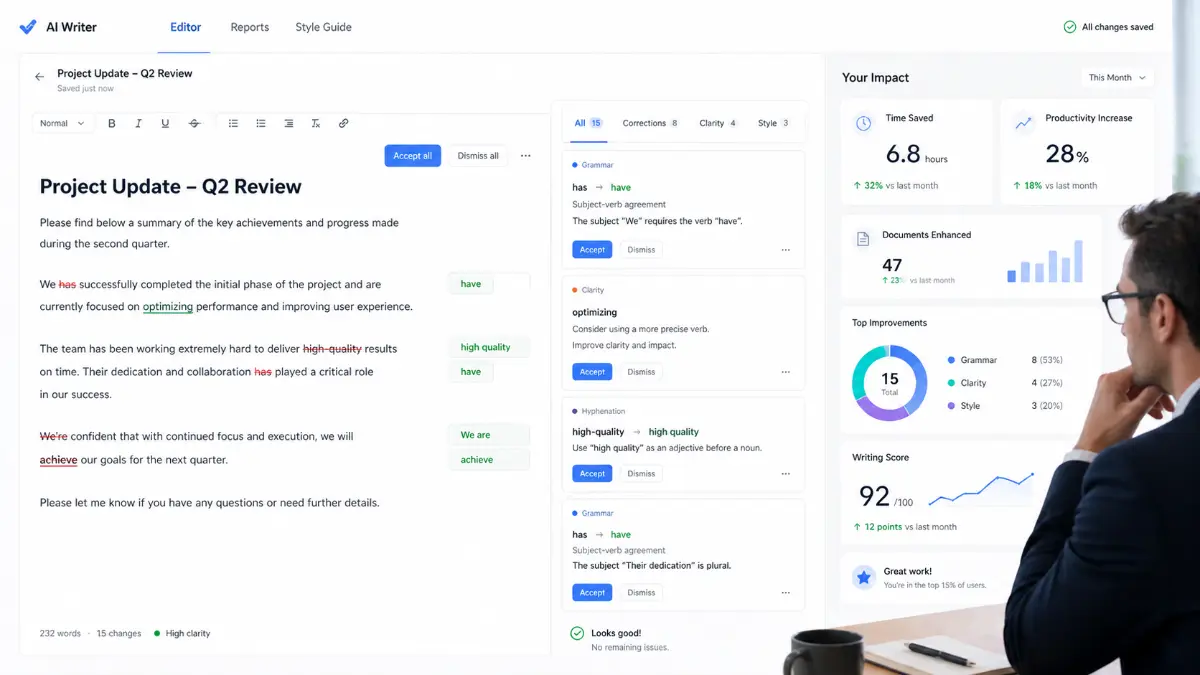
After implementing an AI grammar tool for our team over three months, we noted a 40% reduction in editing time per document, which translated into an additional 25 hours of productive time across our team of editors weekly. The automated writing assistance landscape in 2021 research from Cambridge highlights precisely this shift — organisations are deploying these tools not merely for accuracy, but for operational efficiency at scale.
Automated writing assistance: AI-powered software that analyses written text in real time, providing corrections and suggestions across grammar, style, tone, and clarity — going well beyond the basic spell-check functionality of earlier tools.
Brand Reputation and Enterprise Adoption
Error-laden communication carries a hidden cost that rarely appears on a balance sheet — but its impact is very real. A misplaced apostrophe in a client proposal, a confusing sentence structure in a press release, or an ambiguous instruction in a contract can erode trust in ways that are difficult to recover from.
Fortune 500 companies have responded accordingly. Widespread enterprise adoption of AI writing tools is now standard practice across sectors including financial services, legal, healthcare, and technology. The rationale is straightforward: consistent, polished written output signals professionalism and competence. When every outbound communication — from marketing copy to internal memos — meets a high standard, that consistency becomes part of the brand identity itself.
One practical approach is to think of grammar checkers as a quality assurance layer, similar to how manufacturers use automated inspection systems before products leave the floor. The investment is justified not just by what it catches, but by what it prevents.
Reducing the Mental Load for Non-Native English Speakers
For the significant portion of the global workforce communicating in English as a second or third language, these tools offer something beyond error correction — they reduce cognitive load.
Cognitive load: The total mental effort required to complete a task; in writing, this includes simultaneously managing vocabulary, grammar, tone, and meaning.
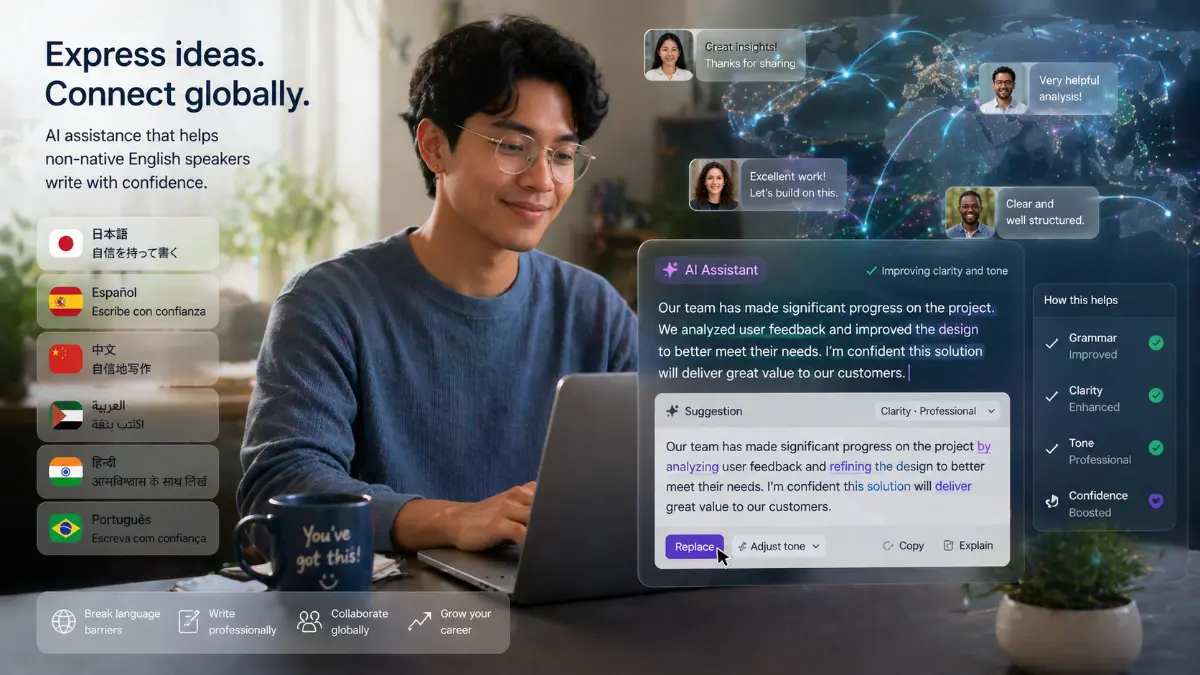
Non-native speakers often describe the experience of writing in English professionally as exhausting — not because they lack ideas, but because constant self-monitoring for correctness depletes mental energy. AI grammar checkers act as a reliable safety net, allowing writers to focus on what they're saying rather than how they're saying it. The confidence this provides has a measurable knock-on effect on output quality and workplace participation.
The commercial case is clear. But the benefits extend beyond business settings entirely — and nowhere is that more apparent than in academic environments, where the stakes are measured in grades, confidence, and long-term outcomes.
Academic Excellence: How Grammar Checkers Influence Student Outcomes
The business case for grammar checkers is compelling — but the academic case may be even more transformative. For students navigating essays, dissertations, and coursework submissions, the difference between a polished piece of writing and an error-laden one can directly influence grades, confidence, and long-term academic trajectory. Grammar checkers are increasingly playing a central role in that journey.
From Red Marks to Real Improvement
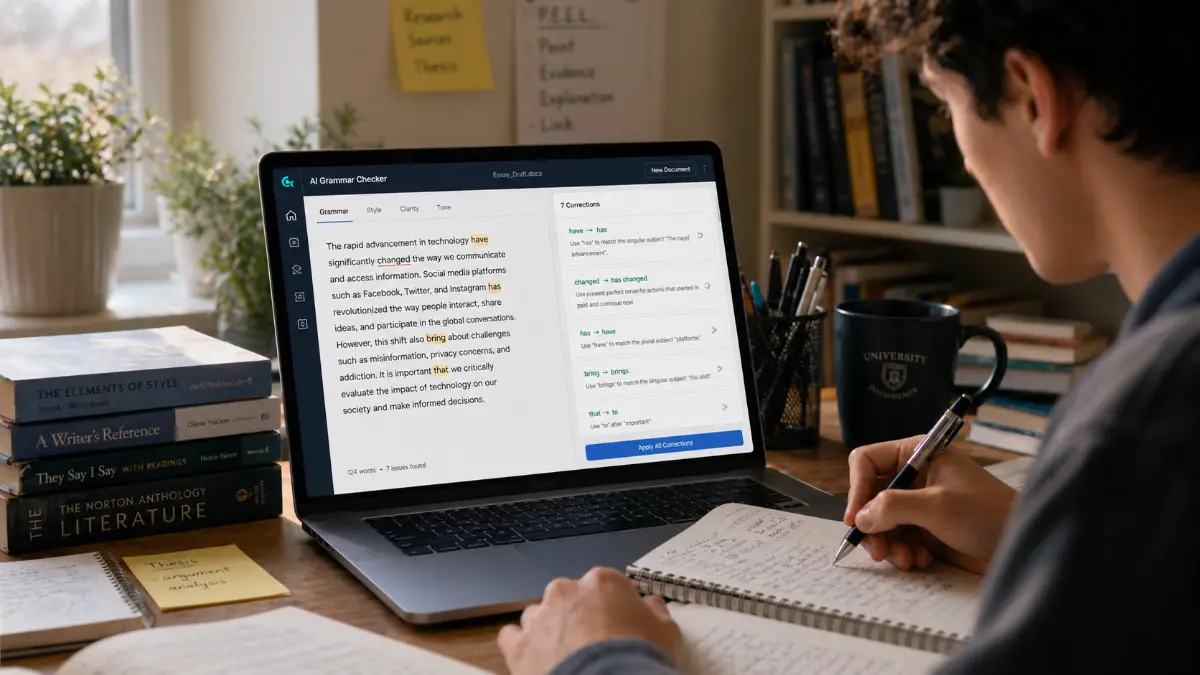
A common misconception is that grammar checkers simply tidy up mistakes before submission — a digital equivalent of a last-minute proofread. In practice, the most effective tools do something far more significant: they teach. Modern AI-powered platforms don't just flag an error and move on; they explain why a sentence is incorrect, offering the grammatical rule or stylistic reasoning behind each suggestion.
Formative feedback: Guidance that helps a learner understand and correct mistakes during the learning process, rather than simply receiving a final grade.
This shift from correction to explanation is where real learning occurs. When a student uses a sentence checker that contextualises its suggestions — explaining, for example, why a comma splice weakens an argument or why passive voice can obscure meaning — they internalise those rules over time. Repeated exposure to this kind of feedback builds genuine grammatical competence, not just cleaner submissions.
The Confidence Effect
Perhaps the most striking finding in recent research involves not grades, but self-perception. Studies examining student attitudes towards grammar checkers report a measurable shift in writing confidence — from an average score of 3.35 to 4.78 on standardised confidence scales — following consistent tool usage. That's a substantial leap, and it signals something important: students don't just write better, they believe they write better.
Writing confidence has a compounding effect. Students who feel secure in their language ability are more likely to attempt complex sentence structures, engage with challenging source material, and produce longer, more developed arguments — all of which correlate with stronger academic outcomes.
The GPA Connection
The correlation between grammar checker usage and improved academic performance is increasingly well-documented. Research published in Natural Language Engineering highlights how automated writing assistance is becoming embedded in academic workflows at scale, with measurable outcomes for student performance. However, it's worth noting a caveat: tools are most effective when students engage with the feedback rather than simply accepting suggestions passively.
The distinction matters. A student who reads each explanation and adjusts their approach develops a transferable skill. One who clicks "accept all" misses the learning opportunity entirely.
As the evidence builds, one question naturally follows: with so many tools available, which ones actually deliver on this promise? The next section breaks down the leading options — so you can choose the right fit for your needs.
Choosing Your Tool: A Guide to the Best Grammar Checkers in 2025
The evidence is clear: automated writing assistance delivers measurable returns for businesses, students, and professional communicators alike. But knowing which tool to choose remains one of the most practical questions facing anyone ready to make the switch. The landscape has matured considerably, and today's leading options serve genuinely distinct needs.
Grammarly: The Benchmark for Professional Writing
Grammarly remains the industry standard by virtually every metric, serving over 40 million daily active users across desktop, browser, and mobile environments. Its AI engine goes far beyond surface-level correction — offering tone detection, clarity suggestions, and style guidance that adapts to professional, academic, and casual contexts. For teams and organisations seeking a reliable, scalable solution, Grammarly's Business tier provides centralised dashboards and brand consistency controls. As reviewed in depth by language educators, its real strength lies in contextual feedback that genuinely helps writers understand why a change improves their work.
QuillBot: The Multilingual and Multidialectal Specialist
Where Grammarly dominates general professional use, QuillBot excels for writers working across multiple languages or dialect registers. Its paraphrasing engine is particularly valuable for non-native English speakers who need to maintain voice whilst correcting structure. For organisations operating across international markets — or students who regularly switch between formal and informal registers — QuillBot offers flexibility that more rigid tools cannot match.
LanguageTool: Privacy-First and Open-Source
Open-source grammar checker: A grammar checker whose underlying code is publicly available, allowing organisations to self-host the software and process documents without sending data to third-party servers.
LanguageTool is the leading choice for privacy-conscious users, including legal teams, healthcare communicators, and public sector organisations bound by strict data governance requirements. Its self-hosted option ensures sensitive documents never leave an organisation's own infrastructure — a caveat that Grammarly and QuillBot, as cloud-based services, cannot offer in the same way.
Scribens and Ginger: Niche Tools Worth Knowing
Scribens appeals to users seeking a lightweight, browser-based free AI grammar checker without account creation or data commitments. Ginger, meanwhile, has carved a niche with its sentence rephrasing features and text-to-speech functionality — particularly useful for writers with dyslexia or those reviewing content for spoken delivery.
Key Takeaways
- Grammarly suits most professional and academic users seeking comprehensive, intelligent feedback
- QuillBot serves multilingual writers and those needing flexible paraphrasing support
- LanguageTool is the go-to for data-sensitive environments requiring on-premise control
- Scribens and Ginger fill specific gaps for niche writing contexts
The right grammar checker is not a one-size-fits-all decision — but in 2025, not using one is no longer a defensible professional position. Choose the tool that fits your context, and let AI-powered grammar checking become your most reliable editorial colleague.
Related articles
Keep reading similar topics
How to Count Words in Microsoft Word: 5 Pro Methods
Need to count words in Word? Learn 5 professional ways to check your word count across desktop, web, and mobile apps with our simple, step-by-step guide.
Precision Word Counter & Character Count Tool | Check Text Now
Ensure your content meets every requirement with our professional online word counter. Get instant, accurate word and character counts to perfect your writing.
How to Count Words Accurately for Academic Papers
Struggling with word count discrepancies? Learn how to count words in a research paper accurately, why your word processor might be giving you the wrong total.